48 Teams at the World Cup: Betting Impact
 Available in US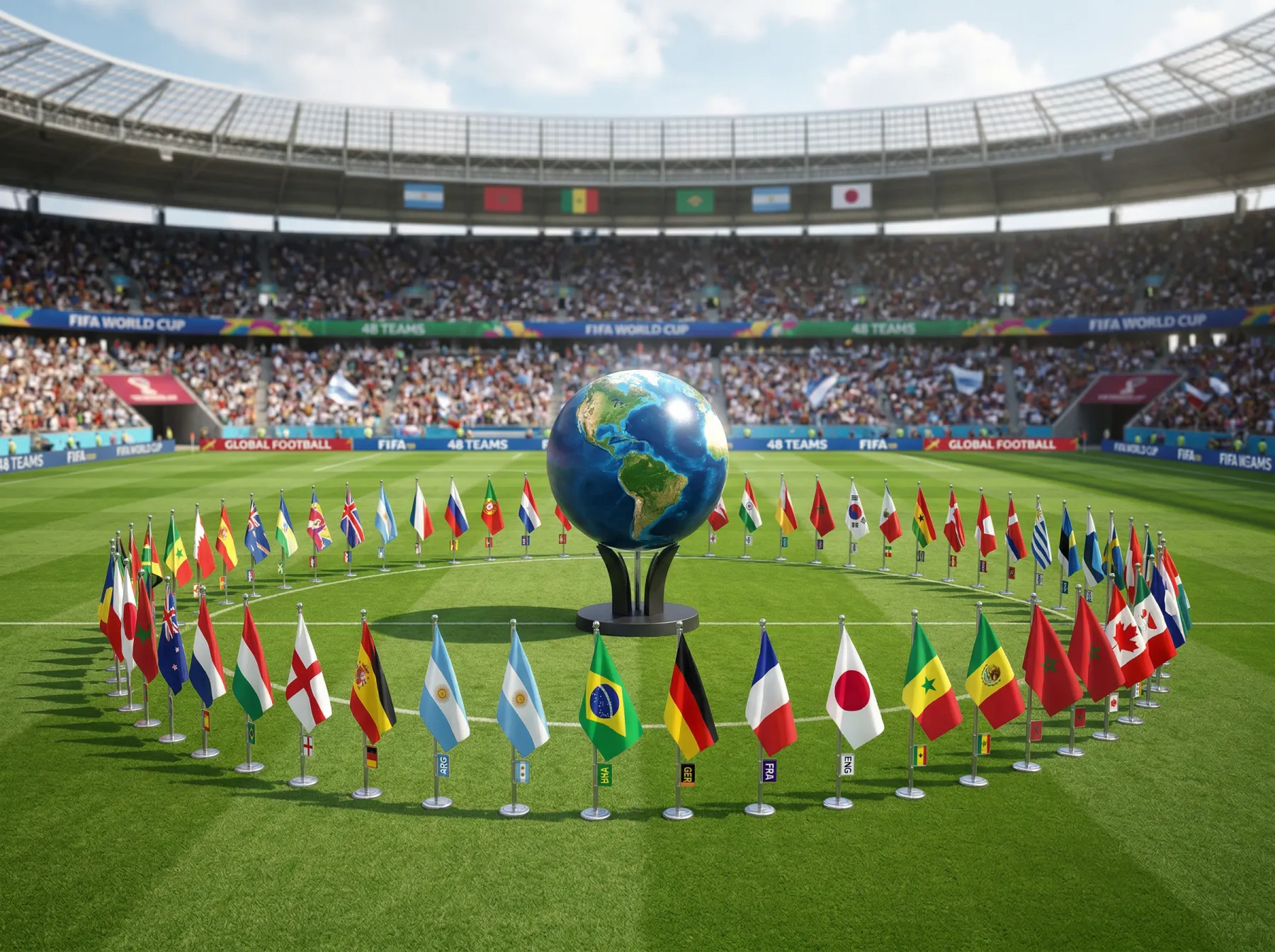
FIFA dreamed big. Gianni Infantino stood at the podium in January 2017 and announced that the World Cup would expand from 32 teams to 48, effective 2026. The football purists groaned. The television networks cheered. The bookmakers started recalculating. Nine years later, the dream is about to become reality, and the betting landscape it creates is genuinely uncharted. No World Cup has ever featured this many teams, this many matches, or this many opportunities for the odds to get it wrong. If you are a punter, the 48-team format is not a footnote. It is the single most important structural change in the tournament’s history, and every bet you place this summer should account for it.
This expansion directly affects the World Cup 2026 groups and bracket structure.
The New Format Explained: 12 Groups, 104 Matches
The mechanics are straightforward but the implications are vast. Forty-eight teams are divided into 12 groups of four. Each team plays three group matches, same as the 32-team format. The top two from each group advance to the Round of 32, joined by the eight best third-placed teams. That makes 32 teams in the knockout phase, which then follows the traditional single-elimination bracket through the Round of 32, Round of 16, quarter-finals, semi-finals, and the final at MetLife Stadium on 19 July.
The total match count rises from 64 (in the 32-team format) to 104. That is 40 additional matches — a 62% increase in the volume of football. The group stage alone produces 72 matches across 18 matchdays, compared to 48 matches across 12 matchdays in the old format. The knockout round adds 32 matches (16 in the Round of 32, 8 in the Round of 16, 4 quarter-finals, 2 semi-finals, a third-place play-off, and the final), compared to 16 knockout matches in the old format.
The tournament duration is 39 days, up from 29 in the 32-team version. Group stage matches run from 11 June to approximately 28 June. The knockout rounds begin on 29 June and conclude with the final on 19 July. For punters, this extended calendar means more betting opportunities per day, more markets open simultaneously, and a greater demand on bankroll management. A disciplined approach that worked across a 29-day tournament may crack under the pressure of 39 days of continuous action.
The third-place qualification rule is the most significant departure from previous formats. Eight of the twelve third-placed teams advance to the knockout round, which means that two-thirds of all third-placed finishers qualify. In practical terms, a team can lose one group match, draw the other two, finish on two points, and still advance as a best third-placed team. This dramatically reduces the cost of a group stage defeat and changes the strategic calculus for managers. In the old 32-team format, losing your opening group match put you under immediate pressure. In the 48-team format, losing your opener is recoverable — you simply need to perform in the remaining two matches and hope your points tally compares favourably with other third-placed teams.
How 48 Teams Changes the Betting Landscape
The most immediate impact is on the outright winner market. In a 32-team tournament, the favourite typically holds odds between 4/1 and 6/1. In a 48-team tournament, the field is deeper, the knockout bracket is longer (an extra round), and the probability of the favourite winning decreases. The 2026 outright market reflects this: no team is shorter than 7/2, and the top five favourites are clustered between 7/2 and 8/1. That compression at the top of the market creates value further down — teams priced at 16/1 to 33/1 in a 48-team tournament represent better risk-adjusted propositions than the same price in a 32-team tournament, because the additional knockout round increases the chance that the top seed is eliminated before the final.
Group winner markets are affected differently. With four teams per group (same as the old format), the group winner dynamics are familiar. But the knowledge that third place is sufficient for qualification changes how teams approach the final group match. A team that has already secured third place with four points may rest key players for the knockout round, producing a dead-rubber match where the result is unpredictable. Betting on final group matches in the 48-team format requires extra caution, because the incentive structure has shifted: qualification is nearly guaranteed for any team with three or four points, which removes the desperation that used to produce dramatic final-day results.
The match result market in the knockout rounds faces a new variable: the Round of 32. This is a stage that has never existed at a World Cup. The 16 matches will pit group winners and runners-up against third-placed qualifiers, creating predictable quality gaps in most fixtures. The market will price these matches accordingly, with heavy favourites in the 1/4 to 2/7 range. The question for punters is whether those prices are short enough. Historically, heavy favourites in World Cup knockout matches have a win rate of approximately 72% — which means roughly one in four of these “safe” results will produce an upset. With 16 Round of 32 matches, expect three or four upsets, and structure your betting accordingly.
Accumulator betting is directly impacted by the expanded format. More matches means more potential acca legs, but the additional variable of third-place qualification and dead-rubber group matches increases the unpredictability of individual results. My recommendation for 48-team accumulators is to keep them shorter than you would in a 32-team tournament — three legs maximum for group stage accas, two legs for knockout accas — and to avoid final group matches entirely as acca components.
More Teams, More Upsets? The Probability Shift
The intuitive assumption is that more teams equals more upsets. Haiti beating Brazil. Curaçao holding Germany. Cape Verde shocking Spain. The romantic appeal of these scenarios is powerful, and the media narrative leading into the tournament will amplify every debutant’s story. But the data from previous format expansions tells a more complicated story.
When the World Cup expanded from 24 to 32 teams in 1998, the group stage produced fewer upsets as a percentage of total matches than the 1994 tournament. The additional teams (Jamaica, Japan, South Africa, Croatia, and others) largely performed as expected: they lost to the favourites, competed against mid-tier opponents, and occasionally produced memorable moments without actually changing the tournament’s outcome. Croatia’s run to the semi-finals was the exception, not the rule, and Croatia were a genuinely talented squad that the pre-tournament odds underestimated.
The 2026 expansion is likely to follow the same pattern. The new entrants — Haiti, Curaçao, Cape Verde, Iraq, Jordan, Uzbekistan, and others — will add colour, stories, and passion to the tournament. What they are unlikely to add is a statistically significant increase in upset frequency. The quality gap between the top 16 teams in the world and the teams ranked 35th to 48th is wider than the gap between the 24th and 32nd teams in 1998. Germany will beat Curaçao. Brazil will beat Haiti. Spain will beat Cape Verde. The mismatches will produce predictable results and inflated scorelines.
Where the upset probability genuinely increases is in the middle band — the matches between teams ranked 10th to 30th in the world, where the quality difference is marginal and match-day factors (crowd, conditions, fatigue, officiating) can tip the balance. Group F (Netherlands, Japan, Sweden, Tunisia) could produce any combination of qualifiers. Group K (Portugal, DR Congo, Uzbekistan, Colombia) has a genuine four-way contest for two qualification spots. Group L (England, Croatia, Ghana, Panama) features a rematch of the 2018 World Cup semi-final between two teams separated by fine margins. These are the groups where upsets will occur, and they are the groups where betting value is highest — not because the results are random, but because the market has not fully priced the competitive balance.
Where the New Value Hides
The 48-team format creates specific pockets of value that did not exist in the 32-team tournament. Identifying them requires understanding how the format changes the incentive structure, the match dynamics, and the probability distributions.
The first value pocket is the “safe third place” market. In several groups, finishing third is almost as good as finishing second — you still advance to the knockout round. This means that some teams will approach their final group match with qualification effectively secured, resting players and accepting a lower-intensity performance. Backing the underdog in these final group matches, or taking the draw at inflated prices, offers consistent value across the 12 groups. I expect four or five final group matches to produce surprising results driven by squad rotation and reduced intensity from the higher-ranked team.
The second pocket is the Round of 32 over/under market. The 16 matches at this stage will feature the widest quality gaps in the knockout phase. Group winners playing third-placed qualifiers will dominate possession and create numerous chances. Historical data from analogous fixtures in continental championships (the Round of 16 at Euro 2016, which also featured third-placed qualifiers) shows a goal average of 2.6 per match — higher than the typical knockout round average. Over 2.5 goals in Round of 32 matches, selectively applied to the most lopsided pairings, should be a profitable angle.
The third pocket is tournament specials that are calibrated to the 32-team format but have not been fully adjusted for 48 teams. Total tournament goals, total red cards, total penalty shootouts — all of these markets scale with match volume, and bookmakers may not fully account for the 62% increase in total fixtures when setting their lines. If the total goals line is set at 260 and the historical average of 2.5 goals per match applied to 104 matches produces an expected total of 260, the line looks fair. But if the expanded format’s mismatch fixtures push the average to 2.7 or 2.8, the expected total jumps to 280-290, and the over becomes a strong position.
The expanded World Cup is new territory for everyone — punters, bookmakers, and the teams themselves. That novelty is where opportunity lives. The bookmakers’ models are built on 32-team tournament data. The 48-team tournament will behave differently in ways that the models have not yet fully captured. Every edge you find this summer will come from understanding those differences before the market catches up. The complete betting guide lays out the strategic framework for approaching these new markets with discipline and clarity.
Understand the new format at World Cup Soccer IE.
