
SoFi Stadium: Los Angeles Venue Guide
 Available in US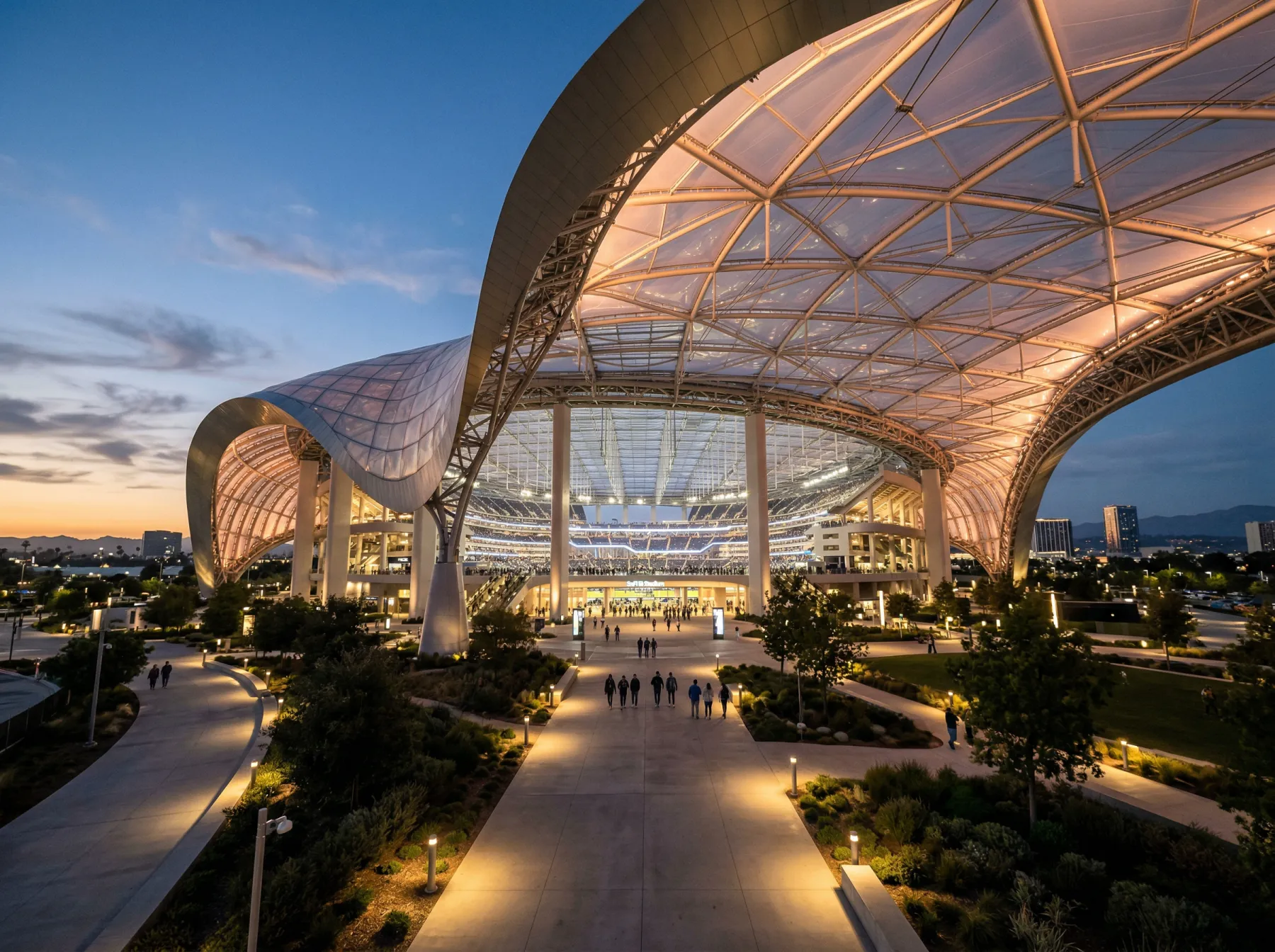
There is a photograph of SoFi Stadium taken from above at night that makes the building look like it landed from another planet. The translucent ETFE canopy, stretching across the roof like a frozen wave, catches the light from inside and glows against the Inglewood skyline. It cost over $5 billion to build — the most expensive stadium in history — and when FIFA needed a venue for the 2026 World Cup’s second semi-final, they looked at this architectural statement and said yes without hesitation. Los Angeles, the city that invented the spectacle, was always going to be part of football’s biggest show.
I have written about stadiums across four continents, and SoFi is unlike anything else in the sport’s current infrastructure. It is not a football ground that happens to be modern. It is a piece of entertainment technology that happens to have a pitch in the middle. For punters betting on World Cup 2026 matches played here, the venue’s unique characteristics — its enclosed environment, its crowd dynamics, its surface — are all worth understanding before the first whistle.
This arena is another highlight of the World Cup 2026 stadiums guide.
SoFi Stadium: $5 Billion and Counting
SoFi Stadium opened in September 2020, missing its intended debut as a 2020 Olympics venue by a year (the Tokyo Games were delayed, but the stadium was ready regardless). It was financed primarily by Stan Kroenke, owner of the Los Angeles Rams and — relevant for many Irish football fans — Arsenal. The $5.5 billion price tag covered not just the stadium but the surrounding Hollywood Park entertainment district, a 300-acre development that includes shops, restaurants, hotels and a performance venue. The complex was designed to be a destination, not just a building you visit for matches.
The stadium’s capacity for football configuration sits at approximately 70,000, which places it in the middle tier of World Cup 2026 venues. The defining architectural feature is the canopy roof — a translucent membrane that covers the stadium without fully enclosing it. The sides of the building are open, allowing natural airflow while protecting spectators and the pitch from direct sun and rain. The effect is a venue that feels indoor in terms of acoustic containment but outdoor in terms of atmosphere and light. For football, this creates conditions that are distinct from either a fully open-air stadium or a fully enclosed dome.
The acoustic properties of SoFi deserve specific attention. The canopy traps and redirects sound in ways that open-air stadiums cannot replicate. During NFL games and the concerts that regularly fill the venue, the noise levels inside SoFi have been measured among the highest of any stadium in the United States. For World Cup matches, this means that well-supported sides — particularly Mexico and the USA, both of which have enormous fan bases in Los Angeles — will benefit from an acoustic home advantage that amplifies crowd noise beyond what the raw attendance numbers would suggest. A sold-out SoFi at 70,000 may sound louder than an 82,000-seat open-air venue like MetLife, simply because the canopy contains the energy.
The pitch at SoFi will be natural grass, installed temporarily over the stadium’s standard artificial turf. Previous installations of natural grass at SoFi — for international friendlies and exhibition matches — have produced mixed reviews regarding surface quality. The playing surface sits below grade level, creating a bowl effect that limits natural airflow at pitch level. In July, with southern California temperatures climbing above 30 degrees, the combination of limited airflow and heat trapped by the canopy could make on-pitch conditions warmer than the outside temperature suggests. This is a more subtle version of the altitude effect at the Azteca: the stadium’s design modifies the natural environment in ways that affect play.
World Cup 2026 Matches at SoFi
SoFi Stadium is confirmed as the venue for a 2026 World Cup semi-final, placing it alongside Hard Rock Stadium in Miami as one of the two stages for the tournament’s penultimate matches. In addition to the semi-final, SoFi will host group-stage fixtures and likely one or two knockout-round matches, totalling approximately five to seven fixtures across the tournament.
Los Angeles hosts one of the most diverse populations in the United States, with significant communities from Mexico, Central America, South Korea, Japan, Iran, and across Africa. The crowd composition at SoFi will shift dramatically depending on which teams are playing. A match involving South Korea, for instance, will draw from the largest Korean-American population in the country, concentrated in the Koreatown neighbourhood of central LA. A match featuring Mexico will feel like an Azteca satellite — Los Angeles has a Mexican-American population that exceeds two million, and every seat available will be claimed.
For the semi-final on 16 July, the crowd will be determined by which teams progress through the bracket. The western-side semi-final path favours teams from Groups A through F, which means potential semi-finalists at SoFi could include Brazil, Mexico, the Netherlands, Germany or Morocco. If Brazil reach the semi-final and play at SoFi, the Brazilian community in Los Angeles — substantial though smaller than Miami’s — will provide passionate support, while a neutral crowd would likely lean toward whichever team is perceived as the underdog. The crowd dynamic at a World Cup semi-final is always intense, but SoFi’s acoustic design will amplify that intensity beyond what you might expect from the attendance figure alone.
Los Angeles and Football: An Evolving Love Story
Los Angeles has a complicated history with football. The 1994 World Cup used the Rose Bowl in Pasadena — technically a separate city — for the final, and that tournament’s success was supposed to launch American professional football into a new era. It did, eventually, but the journey was circuitous. The LA Galaxy, founded in 1996, became the most recognised MLS franchise largely through signing ageing European stars — David Beckham, Steven Gerrard, Zlatan Ibrahimović — while the city’s genuine football culture simmered in the immigrant communities that had always followed the sport.
LAFC’s arrival in 2018 changed the dynamic. Based in Banc of California Stadium (now BMO Stadium) in the Exposition Park neighbourhood, LAFC tapped into the authentic, community-driven football culture that had existed in LA for decades but had never had a proper home. When Messi moved to Inter Miami in 2023 rather than LAFC, it was a blow to the city’s ambitions, but the football infrastructure was already established. By 2026, Los Angeles will host World Cup matches in a city that has two MLS franchises, a massive youth football participation rate, and a population that watches Liga MX, the Premier League, La Liga and Serie A with genuine devotion.
That evolution matters for the 2026 World Cup because it means the audiences at SoFi will be knowledgeable, not merely curious. These are not casual spectators attending a novelty event — they are football fans who understand the sport’s rhythms, who will react to tactical nuances, and who will create an atmosphere that reflects genuine passion rather than manufactured excitement. For visiting European and South American teams, playing in front of a football-literate Los Angeles crowd is a different experience from playing in front of a curious American audience at a more football-naive venue.
From a betting perspective, the sophistication of the LA football audience has a subtle effect on live markets. In-play odds respond partly to crowd reactions — a roar from the crowd after a near miss moves the momentum indicators that some live-betting algorithms use. At SoFi, where the canopy amplifies those reactions, the in-play market may overreact to crowd noise in ways that create brief windows of value. If you are watching a SoFi match on television and monitoring in-play odds simultaneously, listen for moments where the crowd reaction exceeds the on-pitch reality — a blocked shot that sounded dramatic, a penalty appeal that was never close — and look for the market to momentarily misprice the situation. Those windows are short, measured in seconds rather than minutes, but they exist.
SoFi Stadium represents the modern end of the World Cup venue spectrum. Where Estadio Azteca carries the weight of history and MetLife offers raw scale, SoFi delivers technological ambition and acoustic intensity. The matches played here will feel different from those at any other venue — louder, more contained, more influenced by the crowd’s energy bouncing off that remarkable canopy and feeding back into the players’ adrenaline. The complete stadiums guide places SoFi in the context of all sixteen venues, but this is the ground where the 2026 World Cup’s visual identity will be most striking, where the photographs and broadcast images will look most impressive, and where the atmosphere will push at least one match beyond the script and into something that no pre-match model could have predicted.
Does SoFi Stadium have a roof for World Cup 2026 matches?
SoFi Stadium has a translucent ETFE canopy that covers the seating bowl and pitch but does not fully enclose the stadium. The sides remain open, allowing natural airflow while providing shade and weather protection. The canopy traps and amplifies crowd noise, creating an acoustic environment that makes SoFi one of the loudest venues at the tournament.
Which World Cup 2026 semi-final is at SoFi Stadium?
SoFi Stadium hosts one of the two 2026 World Cup semi-finals on 16 July. The specific teams depend on the knockout-bracket results, but the western-side bracket path means potential semi-finalists at SoFi could include Brazil, Mexico, the Netherlands, Germany or Morocco, among others.
Track the Los Angeles matches with World Cup Soccer IE.
