
Estadio Azteca: World Cup Opening Venue
 Available in US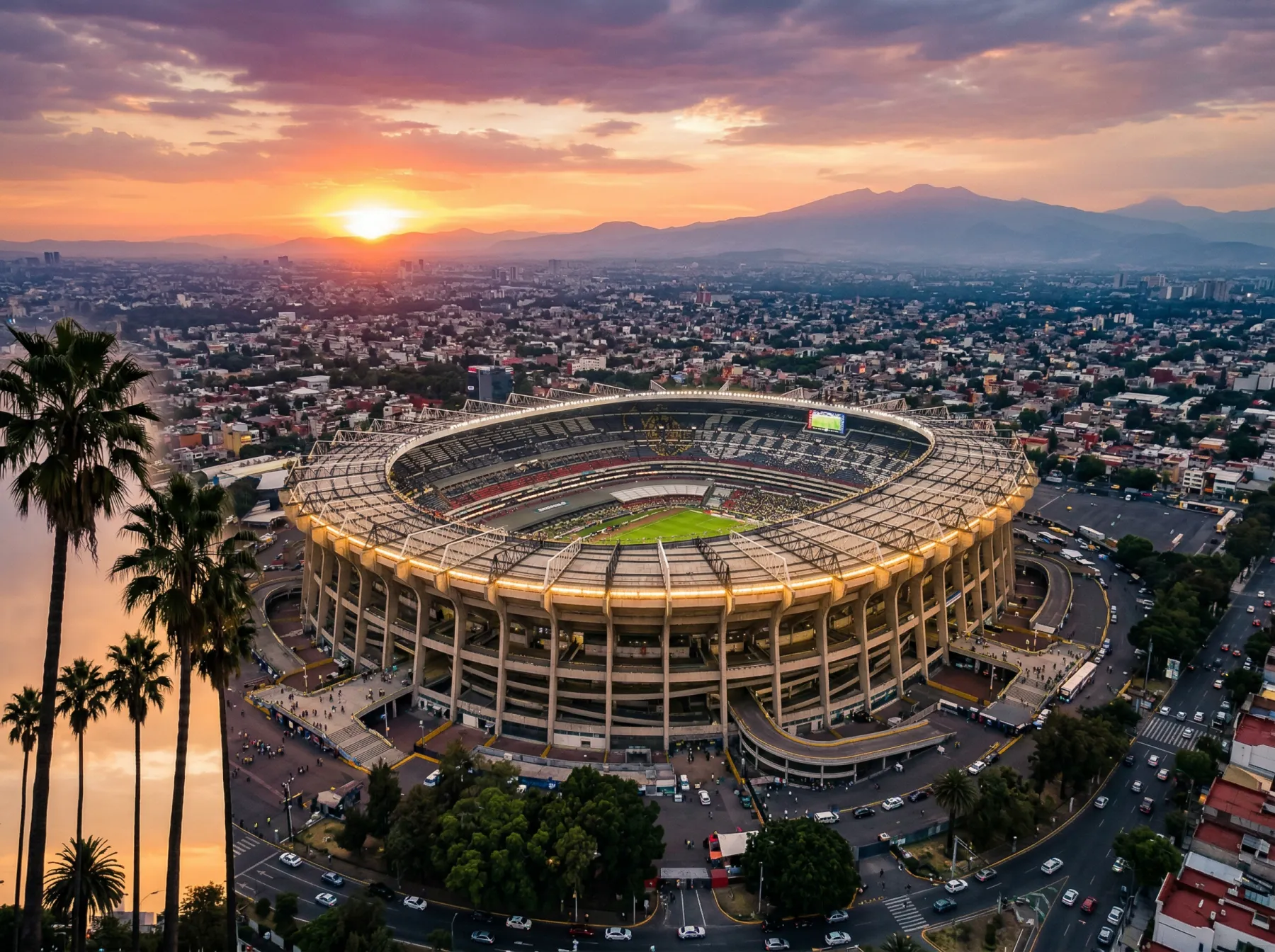
Two moments define Estadio Azteca more than any other stadium on earth. The first: Diego Maradona weaving past five England players on 22 June 1986 to score what is still called the greatest goal in World Cup history. The second: the same Maradona, four minutes earlier in the same match, punching the ball past Peter Shilton with his left fist — the Hand of God. Both happened on the same pitch, in the same afternoon, in a stadium that was already 20 years old at the time and has since watched football evolve around it without ever losing its gravitational pull on the sport’s biggest moments.
On 11 June 2026, Estadio Azteca hosts the opening match of the World Cup for the third time in its history — Mexico versus South Africa — and once again places itself at the centre of a tournament’s opening narrative. For those of us who analyse this sport through a betting lens, the Azteca is not merely a venue. It is a variable: altitude, atmosphere and historical weight combine to produce conditions that measurably affect match outcomes.
Learn more about the venues in our World Cup 2026 stadiums guide.
A Stadium Like No Other: Azteca’s World Cup Legacy
Estadio Azteca opened in 1966, built to host the 1970 World Cup, and it has aged the way great stadiums should — not gracefully, exactly, but with a stubbornness that refuses to accept irrelevance. It hosted the 1970 final, where Brazil’s extraordinary squad — Pelé, Jairzinho, Tostão, Rivelino — dismantled Italy 4-1 in a match that remains the benchmark for attacking football at a World Cup. It hosted the 1986 final, where Argentina beat West Germany 3-2 in a match that swung wildly in both directions. Between those two tournaments, Azteca also staged countless Liga MX matches, CONCACAF qualifiers, and international friendlies that built its reputation as one of the most hostile away grounds in world football.
The stadium’s capacity has shifted over the decades as renovations added and removed sections. For the 2026 World Cup, the seated capacity is approximately 83,000, making it the largest venue in the tournament. Renovations ahead of the World Cup have modernised the interior facilities — media areas, hospitality suites, concourses — while preserving the essential character of the bowl. The lower tiers remain steep and close to the pitch, generating an acoustic intensity that television microphones capture but cannot fully convey. When 80,000 Mexican fans produce a synchronised roar, the air inside the stadium physically vibrates. Visiting teams feel it. Visiting players have spoken about it for decades.
That atmosphere is not just colour — it is a measurable home advantage. Mexico’s record at Azteca in competitive matches across the past 30 years is strikingly dominant. The combination of crowd noise, the intimidation of a vast partisan audience, and the altitude produces conditions that tilt the pitch in the home side’s favour. For the 2026 World Cup, where Mexico open against South Africa with the entire nation watching, that tilt will be at its most extreme. I factor venue-specific home advantage into my pre-match models, and Azteca produces one of the largest adjustments of any ground in international football.
The stadium’s role in World Cup mythology extends beyond individual matches. The Azteca has seen more World Cup matches than any other venue on the planet — a total that will grow further in 2026. It is the only stadium to host two World Cup finals. That historical density matters because it creates a psychological context: players know they are walking into a place where legends were made, where Pelé lifted the Jules Rimet trophy for the last time, where Maradona became something beyond a footballer. That weight can inspire, and it can overwhelm. Teams that thrive on occasion and atmosphere — think of the great Brazilian sides, or Argentina’s emotionally charged squads — tend to perform well in stadiums that carry this kind of history. Teams that prefer clinical, structured environments may find it harder to impose their game plan when the surroundings demand something more visceral.
The Opening Match: Mexico vs South Africa, 11 June
World Cup opening matches have a particular character. They are rarely classics. The weight of the occasion — the ceremony, the global audience, the pressure of firing the first shot in a six-week tournament — tends to produce cautious, tactical affairs. Of the last ten World Cup opening matches, six have produced two goals or fewer. The most recent opener, Qatar versus Ecuador in 2022, ended 2-0 to Ecuador in a match that was decided by the 31st minute and settled into attritional football thereafter.
Mexico versus South Africa on 11 June 2026 follows that pattern of expectation. Mexico, as hosts, carry the obligation to win and the terror of losing in front of their own people in the tournament’s first match. South Africa, for their part, return to the World Cup for the first time since hosting in 2010, where Siphiwe Tshabalala’s opening goal against Mexico in the first match of that tournament remains one of the most joyous moments in African football. The symmetry is poetic — Mexico and South Africa, meeting again in an opening match, 16 years later, on the opposite side of the Atlantic.
The betting market will price Mexico as clear favourites, likely around 4/9 on the match result, with the draw at approximately 7/2 and South Africa at 7/1 or thereabouts. Those prices reflect Mexico’s home advantage, which at the Azteca is worth at least a goal in expected terms. The under 2.5 goals market, probably around 5/6, is the position I find most interesting for this fixture. Opening matches are tight, and Mexico’s coaching staff will prioritise not losing over scoring freely. A 1-0 or 2-0 Mexico win is the most likely outcome — exciting enough for the occasion, controlled enough for Mexican nerves.
For Irish punters, the opening match is the first opportunity to set the tone for your tournament betting. Resist the temptation to bet heavily on the opener simply because it is the first match available. The value in the opening-match market is typically thin, with heavy public money on the host nation compressing the odds below fair value. If you do engage, look at the subsidiary markets — first-half total goals, match cards, and whether both teams score — rather than the match result, where the market is most efficient.
All World Cup 2026 Matches at Estadio Azteca
Beyond the opening match, Estadio Azteca will host additional group-stage fixtures and potentially a round-of-32 match. FIFA typically assigns five to seven matches to the primary host-nation venue, spread across the group stage and the early knockout rounds. The specific fixtures depend on the scheduling matrix, but you can expect at least one more Mexico match at the Azteca during the group stage — likely their second group game against South Korea or Czechia — plus one or two neutral fixtures involving teams from other groups.
The neutral fixtures at Azteca are particularly interesting from a betting perspective because the home advantage that benefits Mexico does not transfer to other teams. When two non-Mexican sides play at the Azteca, the atmosphere becomes more balanced — the crowd is still large and noisy, because Mexican fans will fill the stadium regardless, but the directed partisan energy dissipates. What remains is the altitude effect, which applies equally to both teams and tends to produce matches that slow down in the second half as players tire faster than they would at sea level.
If you are building a tournament-wide betting strategy that accounts for venue effects, the Azteca matches deserve specific attention. Mark the fixtures, note the teams involved, and adjust your expectations for tempo and goals accordingly. A match between two European sides played at the Azteca will likely have a different profile than the same fixture played at sea level in New Jersey or Toronto.
Mexico City: The Altitude Factor
Estadio Azteca sits at 2,200 metres above sea level. That number is not abstract — it is a physiological reality that affects every player on the pitch. At 2,200 metres, the air contains approximately 20% less oxygen than at sea level. The ball travels faster through thinner air, making long passes and shots behave differently. Free kicks dip later, crosses carry further, and goalkeepers need to adjust their positioning for shots that move more quickly than they would in London or Dublin.
The altitude effect on players is well documented. Teams that are not acclimatised — which includes almost every non-Mexican side in the tournament — experience faster onset of fatigue, particularly in the second half. Heart rates are elevated, breathing is heavier, and the recovery time between sprints increases. This is why Mexico’s home record at the Azteca is so strong: they are accustomed to the conditions, while opponents spend the final 30 minutes of matches physically struggling to maintain their shape and intensity.
For the World Cup, FIFA requires teams to arrive at the host city a minimum number of days before their match, which provides some acclimatisation time. However, the research on altitude adaptation suggests that meaningful physiological adjustment requires a minimum of ten days at elevation, and most teams will not have that luxury. The practical effect is that visiting teams will be at a measurable disadvantage in the final third of matches at the Azteca, particularly if the match is played in warm conditions.
This has direct betting implications. The second-half goals market in Azteca matches is skewed by altitude in a way that the general market may not fully capture. Visiting teams tend to concede more goals in the second half at altitude than their overall defensive record would suggest, because their defensive shape deteriorates as fatigue sets in. Backing the home side (Mexico) or the better-conditioned team to score in the second half is a position worth considering for every Azteca fixture. Similarly, the over 0.5 second-half goals market is historically reliable at altitude venues and offers a solid accumulator leg.
The altitude also affects set pieces. Dead-ball situations at the Azteca produce slightly different ball flight characteristics — knuckle-ball free kicks are more unpredictable, crosses from wide areas carry further into the box, and the ball’s flight path on corners is less predictable for goalkeepers. If you are betting on set-piece-related markets — first goalscorer from a corner, header goals — the Azteca’s altitude makes these outcomes marginally more likely than the same markets at sea-level venues. The margins are small, but in a tournament with 104 matches, small edges compound into meaningful returns over time.
How high is Estadio Azteca above sea level and does it affect matches?
Estadio Azteca sits at 2,200 metres above sea level in Mexico City. The altitude reduces oxygen availability by approximately 20%, causing faster fatigue in unacclimatised players, particularly in the second half. The thinner air also affects ball flight, making shots faster and set pieces less predictable. These factors create measurable advantages for acclimatised teams and influence betting markets for matches played at the venue.
What is the opening match of the 2026 World Cup at Estadio Azteca?
Mexico play South Africa in the tournament"s opening match on 11 June 2026 at Estadio Azteca. It marks the third time the stadium has hosted a World Cup opening fixture, following the 1970 and 1986 tournaments. Mexico are expected to be clear favourites, with the home crowd and altitude providing significant advantages.
Follow the tournament start on our homepage.
