
World Cup 2026 Groups and Bracket
 Available in US
The envelope trembled in Cafu’s hands. One by one, the balls emerged, and with each reveal, the narrative of the 2026 World Cup groups took shape. I was watching from a Dublin pub that Sunday afternoon, pint in hand, when Scotland’s name paired with Brazil. The room erupted. Some cheered the romance of it, others groaned at the task ahead. In that single moment, forty-eight storylines crystallised into twelve chapters, and the punting possibilities multiplied exponentially.
This tournament marks the most significant expansion in World Cup history. Twelve groups of four teams each, 104 matches across 39 days, three host nations spanning two time zones. The draw itself was a theatrical production worthy of the world’s biggest sporting event, but for those of us who approach football with a betting slip in mind, the real drama begins now. Which groups conceal value? Where do the mismatches lie? When will the big fixtures kick off in Irish Standard Time, and how does the knockout bracket favour certain sides of the draw?
I have dissected every World Cup draw since 2010 from a betting perspective, and 2026 presents complexities unlike any tournament before it. The expanded format, the geographical spread of venues, and the new qualification pathway for third-placed teams all demand fresh analysis. What follows is a comprehensive breakdown of the World Cup 2026 groups, the full schedule converted to IST, the knockout bracket architecture, and the betting angles that emerge from each element. Whether you are backing Scotland’s Celtic crusade or hunting value in obscure group permutations, this is your roadmap to the tournament.
This bracket is highly influenced by the World Cup 2026 48-team changes.
How the New 48-Team Format Changes Everything
Forget everything you learned from watching thirty-two-team World Cups. The arithmetic of 2026 rewrites the betting playbook entirely. I spent weeks modelling the new structure against historical tournament data, and the conclusions surprised me. The format is not merely bigger, it is fundamentally different in how it distributes opportunity and risk.
Forty-eight teams split into twelve groups of four. Each team plays three matches in the group stage, just as before. The top two from each group advance automatically, giving us twenty-four qualifiers. Here is where the expansion bites: the eight best third-placed teams also progress, creating a round of thirty-two rather than the familiar round of sixteen. From there, the knockout rounds proceed normally through the last sixteen, quarter-finals, semi-finals, and the final at MetLife Stadium.
What does this mean for punters? The group stage becomes simultaneously more forgiving and more chaotic. In previous tournaments, a single loss in the group stage often spelled elimination. Now, a team can lose one match and still progress as a third-placed qualifier. This safety net changes tactical calculations for managers and probability calculations for bettors. Expect more conservative approaches in opening fixtures, with teams happy to bank a draw before pushing for results.
The third-place pathway introduces a fascinating betting angle. Not all third-place finishes are equal. The eight best thirds advance based on points, goal difference, and goals scored. A team finishing third with four points and a positive goal difference is almost certain to progress. A team finishing third with two points and a negative goal difference is heading home. This creates late group-stage scenarios where teams need not just results but specific margins. I anticipate several final matchday fixtures where both teams are playing for goal difference rather than pure victory.
The expanded knockout stage affects outright odds in ways the market has not fully priced. Favourites now need to win seven matches to lift the trophy rather than six. That extra knockout round adds another opportunity for upset, another night where fatigue or injury can derail a campaign. The historical knockout-stage win rate for top seeds hovers around seventy percent. Compound that across seven rounds instead of six, and the probability of a favourite going all the way drops measurably.
Group compositions matter differently in this format. A strong group is no longer purely a curse. Finishing second or third in a difficult group can yield a more favourable knockout draw than topping a weaker group. The seeding for the round of thirty-two places group winners against third-place qualifiers, while group runners-up face each other in designated ties. Understanding these pathways is essential for bracket betting and correctly pricing a team’s route to the final.
The schedule density presents another variable. With 104 matches across 39 days, some teams will have more recovery time between fixtures than others. Venue logistics matter too. A team playing all group matches in Texas before travelling to Seattle for a knockout tie faces different challenges than one based entirely on the East Coast. These factors rarely appear in mainstream analysis, but they influence outcomes and therefore odds.
All 12 Groups at a Glance
When the final ball dropped in Zurich, we had our complete picture. Twelve groups, forty-eight nations, and enough storylines to fill a library. I have mapped each group by difficulty, betting interest, and narrative potential. Some groups offer clear hierarchies where backing the favourite feels safe. Others resemble lottery draws where any outcome seems plausible.
Group A opens the tournament in Mexico City, and the hosts will carry enormous pressure. Mexico faces South Korea, South Africa, and Czechia in what looks like a manageable quartet. The Mexicans are odds-on to top this group, though South Korea’s knockout pedigree and Czechia’s European Championship experience make this no walkover. South Africa returns to the World Cup for the first time since hosting in 2010. The opening match on 11 June pits Mexico against South Africa at the Estadio Azteca, and the atmosphere will be volcanic.
Group B places Canada alongside Bosnia and Herzegovina, Qatar, and Switzerland. The Canadians have home advantage for selected fixtures in Toronto, and Alphonso Davies provides genuine world-class quality. Switzerland remains the model of tournament consistency, reaching knockout rounds at seven consecutive major tournaments. Qatar’s 2022 hosting experience feels distant now, and they lack the squad depth to compete at this level. Bosnia brings passion but limited recent form.
Group C belongs to the dreamers and believers. Brazil headline as favourites, but the supporting cast makes this group endlessly compelling. Morocco arrives as 2022 semi-finalists, carrying African hopes and genuine knockout ambitions. Scotland returns to the World Cup after twenty-eight years in the wilderness, a storyline that resonates deeply with Irish punters given our Celtic bonds. Haiti makes their debut at a men’s World Cup, the ultimate underdog narrative. I will analyse this group in greater detail below, but know this: Group C offers more betting angles than any other quartet in the tournament.
Group D features the United States as hosts, joined by Paraguay, Australia, and Turkey. The Americans will play all three group matches on home soil, with venues including AT&T Stadium in Dallas and Mercedes-Benz Stadium in Atlanta. Turkey’s volatile form makes them dangerous opponents but unreliable betting propositions. Australia brings World Cup experience and physical organisation. Paraguay often surprises in South American qualifying but struggles to translate that to global stages.
Group E presents Germany seeking redemption after their Euro 2024 semi-final exit on home soil. Curaçao makes their World Cup debut representing the Caribbean Netherlands, a remarkable achievement for a nation of 150,000 people. Côte d’Ivoire brings African flair with a golden generation featuring players from Europe’s top leagues. Ecuador continues their emergence as South American dark horses. Germany should top this group, but the margins between second through fourth could prove razor-thin.
Group F assembles a quartet that deserves more attention than it receives. Netherlands face Japan, Sweden, and Tunisia in a collection of genuinely capable sides. Japan’s European-based contingent has transformed them into credible knockout contenders. Sweden rebuild after missing Euro 2024, relying on young talent rather than the Ibrahimovic generation. Tunisia brings North African organisation and a record of competitive World Cup performances. The Dutch are clear favourites, but I would not dismiss any of these three as cannon fodder.
Group G surrounds Belgium with Egypt, Iran, and New Zealand. Belgium’s golden generation makes one final tilt at a major trophy, with Kevin De Bruyne and company now in their thirties. Egypt arrives without Mohamed Salah’s most explosive years but with Liverpool’s talisman still leading the line. Iran’s participation remains subject to geopolitical developments, though FIFA currently confirms their inclusion. New Zealand represents Oceania, having earned their place through intercontinental playoffs.
Group H places Spain alongside Cape Verde, Saudi Arabia, and Uruguay. This group may produce the tournament’s most lopsided contests. Spain’s young squad, featuring Lamine Yamal and Pedri, should dominate possession against all three opponents. Uruguay’s aging core includes veterans from their 2010 semi-final run. Saudi Arabia carries the memory of their stunning 2022 victory over Argentina but lacks consistent quality. Cape Verde makes their World Cup debut, representing African football’s expanding footprint.
Group I positions France as heavy favourites against Senegal, Iraq, and Norway. The French squad remains loaded with attacking talent, though Kylian Mbappé’s form will determine their ceiling. Senegal represents African quality without the injured Sadio Mané. Iraq returns to the World Cup after qualifying through the Asian confederation. Norway finally reaches a major tournament with Erling Haaland, though their overall squad depth limits expectations.
Group J sees defending champions Argentina face Algeria, Austria, and Jordan. Lionel Messi’s tournament participation remains the central question. If fit, Argentina can defend their title. Without him, they become merely one of several contenders. Algeria brings passionate support and African Championship-winning pedigree. Austria’s pressing system under Ralf Rangnick makes them awkward opponents. Jordan qualifies for their first World Cup, representing West Asian football’s growth.
Group K clusters Portugal with DR Congo, Uzbekistan, and Colombia. The Portuguese have transitioned beyond Cristiano Ronaldo, now building around Bruno Fernandes and Rafael Leão. Colombia’s Néstor Lorenzo has restored their attacking identity. DR Congo and Uzbekistan represent emerging federations with limited World Cup experience. Expect Portugal and Colombia to contest top spot while others battle for third-place relevance.
Group L closes our circuit with England, Croatia, Ghana, and Panama. This echoes the 2018 semi-final showdown, with England and Croatia renewing acquaintances. Ghana rebuilds after their 2022 early exit, relying on a new generation. Panama returns to the World Cup carrying CONCACAF credentials but facing a step up in class. England’s Premier League stars will feel the weight of expectation, as always.
The Groups of Death: Where Drama Awaits
Every World Cup produces at least one group where quality exceeds available qualification places. In 2026, the expanded format and third-place pathway theoretically reduce the concept of a true “group of death.” Theoretically. In practice, several groups will still produce heartbreak, upsets, and betting chaos.
Group F stands out as the tournament’s most competitive quartet. Netherlands, Japan, Sweden, and Tunisia each possess genuine knockout-round credentials. The Dutch enter as favourites, but their historical tournament inconsistency makes them unreliable at short prices. Japan’s transformation under Hajime Moriyasu has created a side capable of beating anyone on their day. Sweden’s rebuild has yielded a squad lacking star power but full of tactical discipline. Tunisia consistently punches above their weight at World Cups, holding Denmark scoreless in 2022 before pushing France close. Any permutation of results feels plausible here. Backing all four teams at various prices across different markets offers more value than trying to identify a single winner.
Group C carries different dynamics but equal intrigue. Brazil should top this group comfortably, but the battle beneath them creates betting theatre. Morocco versus Scotland represents the fixture that will define both nations’ tournaments. The winner of that match likely takes second place. The loser enters the third-place lottery. Haiti’s debut adds variance. They could ship eight goals across three matches, or they could defend desperately and cause shock results. Group C’s volatility makes it essential viewing for Irish punters given Scotland’s involvement.
Group L revives memories that cut different directions. England and Croatia replayed their 2018 semi-final narrative when the draw paired them here. That previous encounter ended 2-1 to Croatia in extra time, crushing English dreams in Moscow. Eight years later, the power balance has shifted. England’s squad depth now exceeds Croatia’s aging midfield, though Luka Modrić’s genius cannot be dismissed. Ghana and Panama complete this group, both capable of collecting points against distracted favourites. The group’s competitive nature means even England, at roughly 2/5 to qualify, carries meaningful risk of early elimination.
Group H offers a different kind of death. Spain should dominate utterly, potentially running up cricket scores against Cape Verde. Yet Uruguay lurks with World Cup pedigree and knockout experience. The danger here lies in schedule congestion and physical demands. Spain may rest key players for dead rubber matches, opening windows for upsets. Uruguay’s route to second place looks clear, but Saudi Arabia’s capacity for single-match brilliance makes predictions uncomfortable.
The value play across these groups involves targeting specific match results rather than outright group positions. When four capable teams meet, backing draws becomes statistically justified. When clear hierarchies exist but scheduling favours rotation, backing lower-ranked teams against second-string lineups offers overlooked value. The group stage of this World Cup will produce more surprise results than any previous edition. Position yourself accordingly.
Group C: Scotland’s Date with Brazil and Morocco
Twenty-eight years. That is how long Scottish supporters waited between World Cup appearances. The last Scottish squad to compete at this stage featured John Collins and Colin Hendry. Craig Burley scored against Norway in France 1998. Then came the wilderness years, the near misses, the qualifying heartbreaks. Now Scotland faces Brazil, Morocco, and Haiti in Group C of the 2026 World Cup. For Irish punters with Celtic solidarity in our hearts, this group demands close attention.
Steve Clarke has built a squad designed for tournament football. Andy Robertson provides genuine world-class quality at left-back. John McGinn offers Premier League experience and goal threat from midfield. Scott McTominay’s transition to a more advanced role has unlocked his scoring instincts. Che Adams leads the line with physical presence and work rate. This is not a Scottish squad hoping merely to participate. This is a Scottish squad aiming to progress.
Brazil present the obvious challenge. The Seleção enter as group favourites at prohibitive odds, and rightly so. Their attacking talent across Vinícius Jr, Rodrygo, and the emerging generation exceeds Scotland’s defensive capabilities. The historical record offers no comfort either. Brazil have never lost to Scotland in competitive football. This match will likely determine whether Scotland takes first or second place in their remaining fixtures.
Morocco represents the defining contest. The Atlas Lions reached the 2022 semi-finals through defensive excellence and knockout resilience. Achraf Hakimi anchors their right flank, while Youssef En-Nesyri provides target-man threat. Morocco will approach this group expecting to finish second behind Brazil. Scotland versus Morocco could reasonably end 0-0 or 3-2. The variance makes betting difficult but viewing compelling. I lean toward under 2.5 goals given both sides’ tactical conservatism.
Haiti’s World Cup debut creates asymmetric risk. On paper, Scotland should win this match comfortably. In practice, World Cup debutants often exceed expectations in their opening fixture before reality sets in. Haiti will play with nothing to lose, their supporters creating Caribbean carnival atmosphere wherever they appear. Scotland cannot afford to take this fixture lightly. The points from Haiti could determine whether they finish second or third, and that distinction matters enormously for knockout-bracket positioning.
My Group C projection places Brazil first, Scotland second, Morocco third, and Haiti fourth. That outcome would see Scotland advance automatically while Morocco enters the third-place lottery. The margins are thin though. A single goal across those three fixtures could flip the entire hierarchy. Irish punters should approach Group C as the emotional anchor of their tournament viewing while maintaining analytical distance in their betting.
Full Match Schedule in Irish Standard Time
The alarm clock will ring at inconvenient hours this summer. Most World Cup 2026 matches take place in the United States, meaning Irish punters face a significant timezone challenge. I have converted every key fixture to Irish Standard Time so you can plan your viewing, your sleep, and your live betting accordingly.
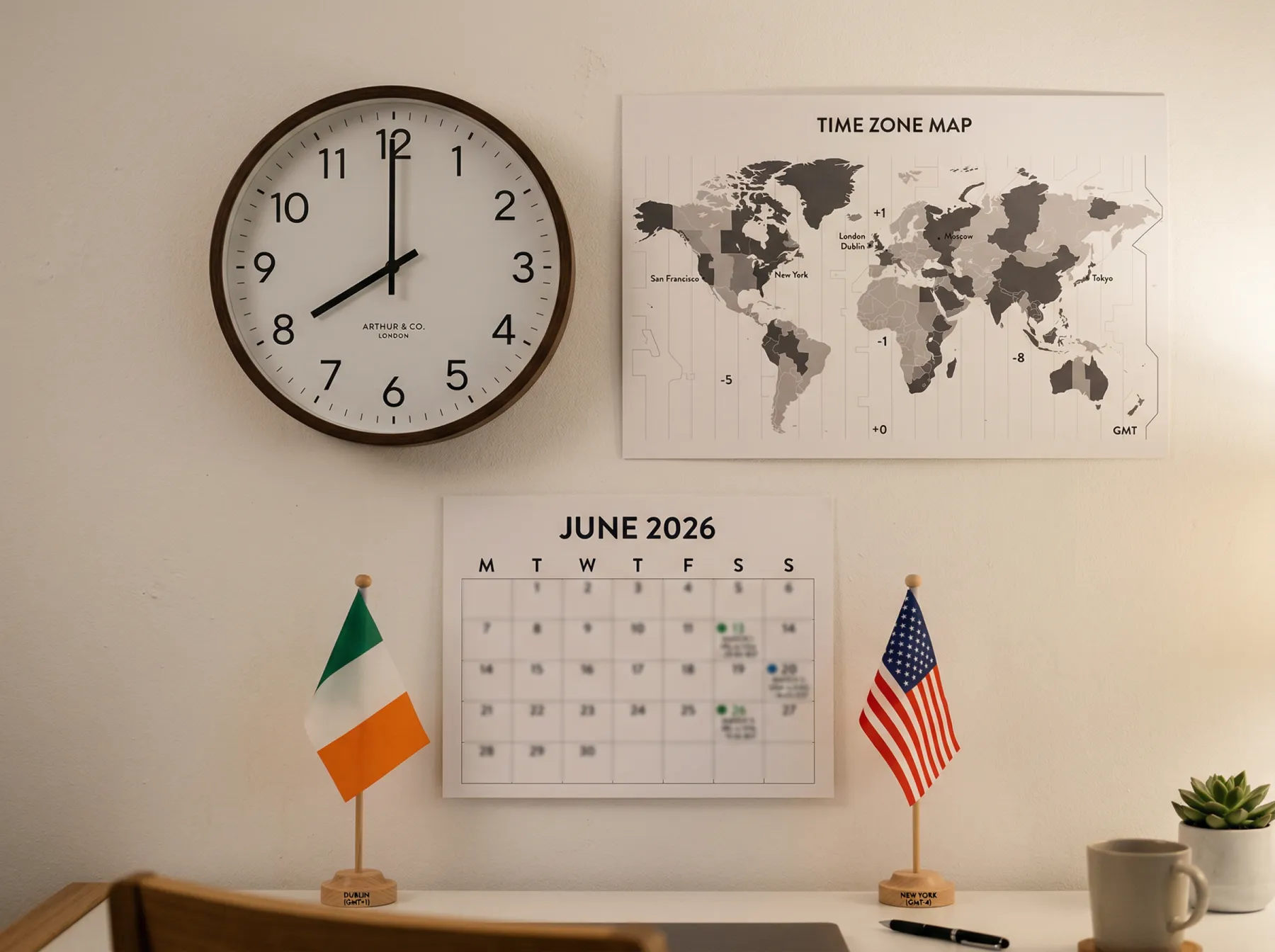
Ireland operates on IST during the tournament window, which is UTC+1. The United States spans multiple time zones, but most World Cup venues sit in Eastern, Central, or Mountain time. The practical result: expect kickoffs ranging from 5:00 PM IST for early fixtures to 2:00 AM IST for late games on the US West Coast. The tournament opens on 11 June 2026 with Mexico versus South Africa at the Estadio Azteca, kicking off at 10:00 PM IST. The final on 19 July begins at 9:00 PM IST at MetLife Stadium in New Jersey.
Group stage fixtures follow a pattern. Early kickoffs at 12:00 PM local time in East Coast venues translate to 5:00 PM IST. These slots favour Irish viewing, allowing afternoon matches to finish before evening plans. The 3:00 PM local kickoffs become 8:00 PM IST, perfect for prime-time watching. The challenging slots are 6:00 PM and 9:00 PM local times, translating to 11:00 PM and 2:00 AM IST respectively. Mexico and Canada host afternoon fixtures with similar conversions, though the one-hour difference means slight variations.
Scotland’s Group C schedule presents mixed fortunes for Irish viewers. Their opening match against Morocco kicks off at 8:00 PM IST, a civilised time for gathering in the pub. The Brazil fixture falls at 11:00 PM IST, requiring either a late night or early morning recovery. Their final group match against Haiti starts at 5:00 PM IST, allowing afternoon viewing and early evening celebrations. I recommend prioritising the Morocco match for in-person viewing and catching Brazil at home with a clear diary the following morning.
The knockout rounds compress the schedule further. Round of thirty-two matches occur across four days, with eight fixtures daily. This density means some evenings will offer continuous football from 5:00 PM IST through 2:00 AM IST. Pacing your viewing becomes essential. Not every match deserves your full attention. Prioritise fixtures involving your outright picks, your accumulator selections, and your bracket predictions.
Live betting considerations multiply with timezone awareness. The 2:00 AM IST kickoffs present both risk and opportunity. Bookmaker attention decreases during unsociable hours, meaning prices sometimes lag market movements. I have found value in late-night fixtures where sharp money has not fully corrected opening lines. Conversely, betting tired at 3:30 AM rarely produces optimal decision-making. Set stakes limits before late fixtures begin, and honour them regardless of in-play temptation.
The quarter-finals through final return to sensible IST times. Quarter-final kickoffs land between 5:00 PM and 11:00 PM IST across four days. Semi-finals occupy 8:00 PM IST slots. The final at MetLife Stadium begins at 9:00 PM IST on 19 July, allowing a full evening of anticipation before the world’s biggest sporting event concludes. Mark your calendar now. Book the following Monday off work. You will need it.
The Road to MetLife: Knockout Bracket Breakdown
Every punter knows the feeling. Your outright pick cruises through the group stage, and then the bracket opens. They face the tournament favourite in the quarter-finals while an easier path existed on the other side. The 2026 knockout bracket structure creates winners and losers before a single elimination match kicks off. Understanding this architecture separates informed betting from guesswork.
The round of thirty-two pairs group winners against qualified third-placed teams, while group runners-up face each other. This structure rewards topping your group with a theoretically weaker opponent. The eight third-placed qualifiers slot into predetermined positions based on which groups they emerge from. The complexity here exceeds previous tournaments. A team finishing third in Group C might face the Group L winner, while a third-place finisher from Group F faces the Group I winner. These pathways are fixed by FIFA’s bracket design.
The bracket splits into two halves leading to separate semi-finals. Group A, C, E, G, I, and K winners populate one half. Group B, D, F, H, J, and L winners populate the other. This means certain group winners can only meet in the final, while others might clash as early as the quarter-finals. For bracket betting and outright pricing, this distribution matters enormously.
Consider the practical implications. Brazil, likely topping Group C, sits on the same half as Germany from Group E, France from Group I, and Portugal from Group K. Those four favourites could face each other in quarter-finals and semi-finals, creating guaranteed attrition among frontrunners. Meanwhile, Argentina from Group J, England from Group L, and Spain from Group H occupy the opposite half with Netherlands from Group F and the United States from Group D. The concentration of talent differs between halves, and the odds should reflect this.
Venue assignments add another layer. Quarter-finals rotate between East Coast and West Coast venues. A team playing in Miami for the quarter-final might fly to Seattle for the semi-final. These logistical factors affect preparation, recovery, and performance. Teams with favourable venue sequences gain marginal advantages that compound across knockout rounds. The final at MetLife Stadium in New Jersey favours teams based on the East Coast through the semi-finals, avoiding transcontinental travel in the tournament’s final week.
Scotland’s potential knockout path illustrates the bracket’s impact. If Scotland finishes second in Group C, they face a group runner-up from the designated pairing. If they finish third, they face a group winner from a different designated slot. Second-place finish yields a more navigable path. Third-place finish could mean facing Argentina or France in the round of thirty-two. This distinction makes the group stage itself a bracket consideration. Sometimes losing a match strategically to finish in a different position offers better tournament odds. I am not advocating match-fixing, merely observing that group position affects knockout fate.
For outright betting, I weight bracket paths heavily. A team priced at 12/1 with a favourable draw offers better expected value than a team priced at 10/1 facing a murderer’s row. Check the bracket structure before placing outright bets. Your winner needs seven victories, and those seven opponents matter. The path through lesser opposition is worth betting premium.
Group Stage Betting: Where the Value Hides
The group stage accounts for forty-eight of the tournament’s 104 matches. That density creates opportunity. Markets are deep, attention is scattered, and bookmakers cannot price every permutation perfectly. I have identified several structural advantages that informed punters can exploit.
Draw frequency increases in expanded tournaments. When sixteen extra teams participate, the quality gap between bottom seeds narrows. Matches between third and fourth seeds in any given group historically produce draws at elevated rates. The 2026 format amplifies this effect. Teams needing a single point to secure third-place qualification will happily accept 0-0 scorelines. Build your accumulator strategy around this reality. Instead of backing clear winners in lopsided groups, consider draw-no-bet or draw insurance options. The extra protection compounds over multiple selections.
First goalscorer markets in group stage openers carry inefficiencies. Bookmakers price these markets based on expected match scripts, but opening fixtures at World Cups follow different patterns. Defensive caution typically dominates, with goals often arriving from set pieces rather than open play. Defenders and central midfielders who attack dead balls become overvalue propositions. Look for centre-backs with heading ability and free-kick takers among midfielders rather than natural strikers priced as favourites.
Over/under goal lines require group-specific analysis. Some groups will produce defensive chess matches. Others will feature basketball scorelines. Group A, with Mexico’s attacking style against South Africa’s defensive frailties, should trend toward overs. Group G, where Belgium’s pragmatic approach meets Egypt’s organisation, should trend toward unders. Avoid blanket over/under strategies across the tournament. Each group possesses its own character based on the playing styles assembled.
Correct score betting offers the tournament’s highest variance and highest potential returns. I recommend small-stakes approaches to 1-0 and 2-1 scorelines in matches featuring clear favourites against defensively organised underdogs. The pattern repeats at every World Cup. Germany beats Curaçao 2-0, not 5-0. Spain beats Cape Verde 3-0, not 7-0. Underdogs compact, cede possession, and limit scoring opportunities. The favourites’ inability to break through increases late-game tension but rarely changes outcomes. Price these scorelines appropriately.
Group qualification parlays present the tournament’s most compelling long-term play. Selecting which teams from each group advance, regardless of position, allows for broader coverage than strict group winner bets. In competitive groups like Group F or Group C, backing any two teams to qualify opens multiple pathways to success. The odds reflect this flexibility, but the probability of hitting two from four where three might advance makes these wagers attractive.
Live betting during group stages requires schedule awareness. When two group matches occur simultaneously on the final matchday, the interaction between fixtures creates opportunity. A goal in one match might change qualification odds in the other, but in-play markets do not instantly reflect cross-match implications. The punter who monitors both fixtures simultaneously gains information advantage over the bookmaker’s algorithms.
From the Draw to the Final Whistle
The World Cup 2026 groups represent the most complex tournament architecture in football history. Twelve groups, forty-eight teams, a third-place qualification pathway, and a knockout bracket spanning sixteen venues across three countries. For punters, this complexity creates opportunity. The market cannot perfectly price every permutation. Your edge lies in understanding the structure, identifying the value, and maintaining discipline across thirty-nine days of football.
Scotland’s presence in Group C gives Irish punters an emotional stake beyond abstract betting interest. When Andy Robertson leads the Tartan Army against Brazil at 11:00 PM IST, we will be watching alongside our Celtic cousins. When the knockout bracket reveals Scotland’s path forward, we will chart their journey to MetLife or their departure with equal investment. The tournament’s structural complexities fade when the ball rolls. What remains is football, and football always delivers stories worth telling. Position yourself to profit from those stories, but do not forget to enjoy them. The next World Cup feels a lifetime away. This one begins in June.
How many teams qualify from each World Cup 2026 group?
The top two teams from each group qualify automatically, giving twenty-four guaranteed knockout participants. Additionally, the eight best third-placed teams across all twelve groups also advance. This means twenty-four plus eight equals thirty-two teams in the knockout rounds, compared to sixteen in previous thirty-two-team tournaments.
What time do World Cup 2026 matches kick off in Ireland?
Match times in Irish Standard Time range from 5:00 PM for early afternoon fixtures on the US East Coast to 2:00 AM for late evening matches on the West Coast. Most group stage matches fall between 8:00 PM and 11:00 PM IST, with the final at MetLife Stadium beginning at 9:00 PM IST on 19 July 2026.
Which World Cup 2026 groups are considered the groups of death?
Group F, containing Netherlands, Japan, Sweden, and Tunisia, presents the most competitive quartet where any team could progress or be eliminated. Group C with Brazil, Morocco, Scotland, and Haiti offers narrative drama with 2022 semi-finalists Morocco facing Scotland"s returning Tartan Army. Group L revives the England versus Croatia rivalry from 2018.
Follow the tournament tree at World Cup Soccer IE.
