World Cup 2026 Live Betting Strategy
 Available in US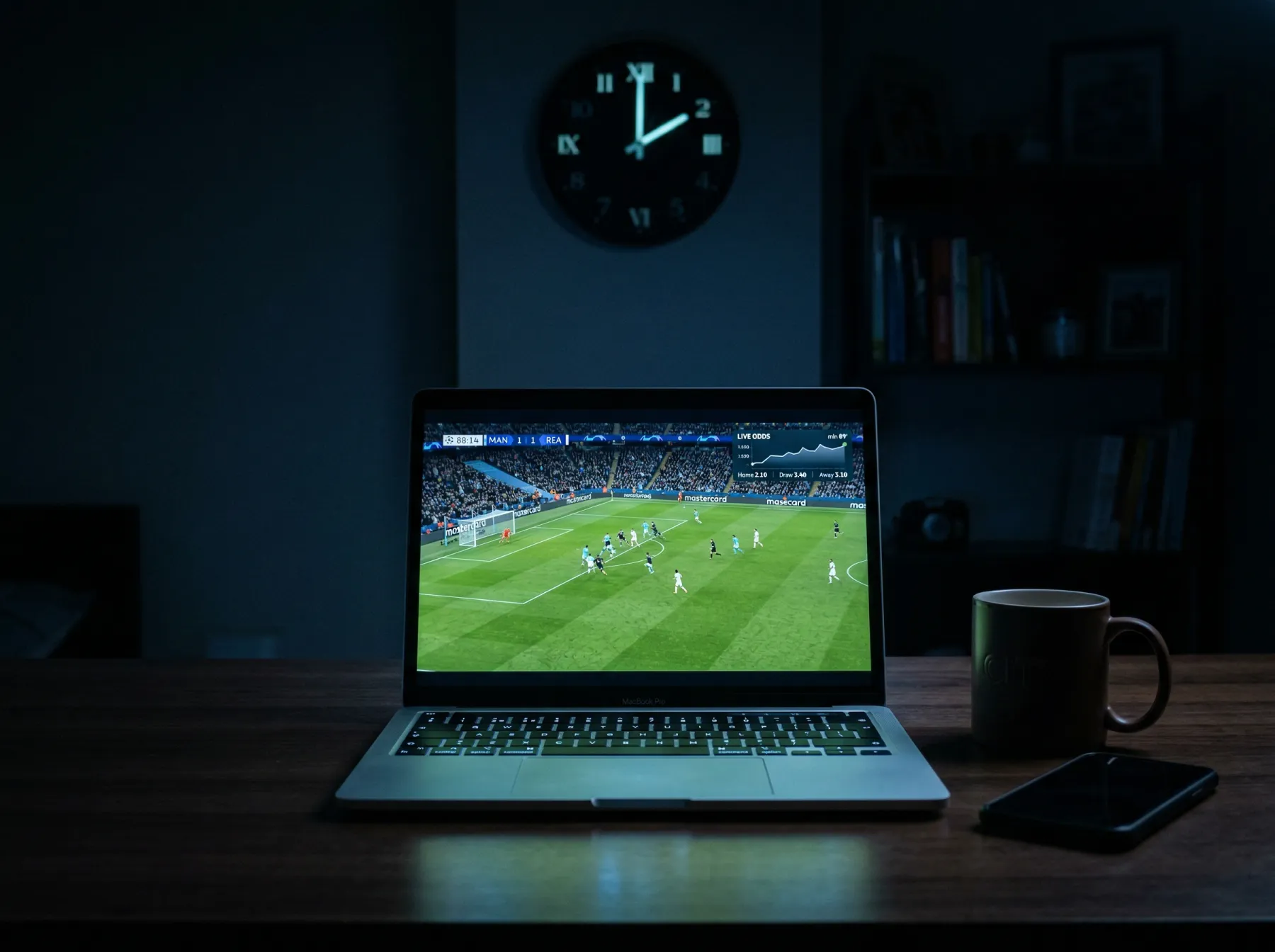
It is ten past two in the morning. The flat is dark except for the bluish glow of your laptop screen. Somewhere in Houston, a World Cup group stage match has just entered the second half, and the pre-match favourite is losing 1-0 to a team ranked forty places below them. The in-play odds have swung violently. The favourite, who opened at 1/3, is now available at 6/4. Your finger hovers over the bet button. Your brain is running two calculations simultaneously: is this value, or is this exhaustion pretending to be insight?
That scene will play out in thousands of Irish homes during the 2026 World Cup. The tournament’s North American time zones mean that the majority of matches kick off between 5pm and 2am Irish Standard Time. The evening fixtures are manageable. The late ones — 11pm and midnight kickoffs — land squarely in the danger zone for in-play betting: late enough that fatigue dulls judgement, early enough that you tell yourself you can handle it. This World Cup 2026 live betting strategy is built for that reality. Not the ideal punter watching in perfect conditions, but the real one — tired, excited, and facing a screen full of shifting numbers.
Live betting works best when you are familiar with the World Cup 2026 groups and bracket.
The Irish Timezone Challenge: Staying Sharp at 2am
The 2026 World Cup is hosted across three time zones in North America. Eastern Time governs the majority of US venues, Central Time covers Houston, Dallas, and Kansas City, and Pacific Time applies to Seattle, Los Angeles, and San Francisco. Mexico City and its Estadio Azteca sit in Central Daylight Time, which aligns with the US Central zone. For Irish punters, the conversion is straightforward but punishing: IST (Irish Standard Time, UTC+1) runs five hours ahead of Eastern Time during the summer.
A match kicking off at 9pm ET in New Jersey starts at 2am IST. A 6pm ET kickoff in Miami starts at 11pm IST. Even the earliest daily fixtures — noon ET — begin at 5pm in Dublin, which is workday territory for most people. There is no comfortable overlap. You are either watching during your evening, which means kickoffs between 5pm and 8pm IST and the match ending before 10pm, or you are into the late-night zone where decision-making degrades with every passing hour.
Research on cognitive performance consistently shows that reaction time, risk assessment, and impulse control decline significantly after midnight for individuals on a standard sleep schedule. A 2019 study from the University of Zurich found that financial risk-taking increases by 20-30% in sleep-deprived subjects compared to rested controls. You do not need an academic citation to confirm what you already know from experience: the bet you place at 2:15am on a Tuesday is not the same quality as the bet you place at 7pm on a Saturday.
My first rule for World Cup live betting from Ireland is simple: set a hard cutoff time and obey it. If midnight is your limit, close the betting app at midnight regardless of the match situation. If 1am is your line, stick to it. The market does not care whether you are awake. The odds will still be there tomorrow for the next fixture. What will not be there tomorrow is the money you lost because you were too tired to recognise a bad bet at a quarter past two in the morning.
Reading Momentum: When to Strike In-Play
Live betting is not the same as pre-match betting with updated information. It is a fundamentally different discipline, because the odds are reacting to events in real time and the bookmaker’s algorithm is faster than your brain. The in-play price after a goal is usually efficient within 90 seconds. By the time you have processed what happened, assessed the tactical implications, and navigated to the betting slip, the value has already been absorbed into the line. Chasing price movements is a losing strategy over any meaningful sample size.
What the algorithm struggles with is context that does not show up in the scoreline. This is where human observation beats the machine, and it is where your live betting edge lives.
The first contextual signal is tactical shape after substitutions. When a manager brings on an extra attacker at 1-0 down, the algorithm adjusts the goal probability upward. What it cannot fully price is whether the substitution has exposed a structural weakness in defence. A team chasing a goal with three forwards and a high defensive line is significantly more vulnerable to a counter-attack than the raw substitution data suggests. If you are watching the match and you see a defensive gap opening up — a full-back caught upfield, a centre-back dragged wide — the in-play over/under or next goal market may offer value that the algorithm has not yet captured.
The second signal is physical condition in the final twenty minutes. World Cup matches in North American summer heat, particularly in Houston (average June temperature of 33°C with extreme humidity), Miami (32°C, coastal humidity), and Dallas (36°C, dry heat), will produce visible fatigue. Teams that dominated possession in the first half may lose territorial control entirely after the 70th minute. Watch for players walking between phases of play, defenders failing to track runners, and midfielders who stop pressing. These are indicators that the live match odds — which weight recent xG data and possession stats — are overestimating a team’s ability to sustain their level of performance. The in-play market often lags behind visible fatigue by five to ten minutes. That window is your opportunity.
A practical example: imagine Brazil leading Haiti 2-0 at half-time in their Group C opener. The in-play odds will have Brazil priced at something like 1/50 to win the match and the over 2.5 goals line will already be settled. But the second-half market — over 1.5 second-half goals, for instance — might still offer value if you can see that Haiti’s defensive shape has collapsed and Brazil’s substitutes, fresh and eager to impress, are attacking with more urgency than the starters. The algorithm knows the score. You know the body language. The third signal is referee behaviour in high-pressure matches. Group stage deciders, where both teams need a result to qualify, tend to produce more fouls, more cards, and more penalties than the opening round fixtures. The bookmakers price card markets and penalty markets based on tournament averages, but specific match contexts — a must-win game between two physical teams — push the actual probability well above the average. If you are watching a tense final group match and the referee is reaching for his pocket early, the over cards market or the penalty to be awarded market may carry value.
Best Live Markets for World Cup Matches
Not all in-play markets are created equal. Some are priced efficiently by the algorithm and offer no edge to the observant viewer. Others are softer, less liquid, and more responsive to the kind of contextual reading I have described above.
The match result market (1X2) is the most liquid and the most efficient. The bookmaker’s model adjusts this price within seconds of any significant event. Unless you have a strong directional view based on something the model cannot see — a key injury that happened off-camera, for instance — the match result market is not where your in-play value lies.
Next goal scorer is where casual punters lose money. The market suspends during attacks, adjusts rapidly after substitutions, and prices star players at a premium that reflects their name recognition rather than their current involvement in the match. I avoid this market entirely during live betting.
The markets I target during World Cup live betting are these: over/under total goals (particularly the 0.5 and 1.5 lines in the second half), both teams to score in the second half, and corners over/under. These markets are less liquid, which means the bookmaker’s algorithm prices them with wider margins but also adjusts them more slowly. A visible shift in tactical shape — one team pushing players forward, the other sitting deeper — creates a predictable increase in corner frequency and goal probability that the corner and goals markets take longer to reflect.
For the 2026 tournament specifically, I expect the altitude factor in Mexico City fixtures (the Estadio Azteca sits at 2,240 metres above sea level) to produce unusual second-half patterns. Teams unaccustomed to altitude tend to fade dramatically after the 60th minute, and the in-play models may not fully account for this because altitude data is not a standard input in most pricing algorithms. If you are watching a Mexico City match and you see a non-Mexican team visibly struggling for breath, the second-half goals market is likely underpriced.
Late-Night Discipline: Protecting Your Bankroll
I have saved this section for last because it is the most important and the least exciting. Discipline does not produce the dopamine hit of a landed in-play bet. It does not make for good pub stories. But it is the single factor that separates punters who enjoy a World Cup from punters who spend August regretting one.
The first discipline tool is a session stake limit. Before you sit down to watch any evening or late-night World Cup match, decide the maximum amount you will wager during that session. Write it on a Post-it note and stick it to the edge of your screen if you have to. When you hit that number, you stop betting and just watch the football. The match is still entertaining without money on it. I know that sounds obvious, but at 1am with adrenaline flowing and odds moving, the obvious becomes invisible.
The second tool is the one-bet rule for late-night sessions. After midnight IST, limit yourself to a single in-play bet per match. One bet. Choose it carefully, place it, and then put the phone down. The compulsion to follow one bet with another — to hedge, to chase, to “lock in profit” with a second position — is strongest when you are tired and the match is producing drama. One bet eliminates that cycle. If it wins, great. If it loses, you lose one stake. Either way, you go to bed without the sinking feeling of a session that spiralled.
The third tool is a 24-hour review period. After every live betting session, wait a full day before placing your next in-play bet. Use that time to review what you wagered, why you wagered it, and whether your reasoning was sound. If you find that your 1am bets consistently lose while your 7pm bets consistently win, the data is telling you something about your late-night decision-making. Listen to it.
The 2026 World Cup will deliver extraordinary football across five weeks, and the live betting markets will be more active than any previous tournament. The opportunity is real. So is the risk. Watch the matches, enjoy the drama, and when you bet in-play, bet with a strategy that was built in daylight, not improvised in the dark. That is the edge that matters more than any odds movement or momentum read — the edge of knowing yourself, your limits, and the point at which the smart play is to close the app and go to sleep.
For the full tactical breakdown of pre-match markets, odds formats, and bankroll management, the complete World Cup betting guide covers everything you need before the first whistle blows.
What time do World Cup 2026 matches kick off in Irish time?
Most matches will kick off between 5pm and 2am Irish Standard Time (IST). The earliest daily fixtures start at approximately 5pm IST (noon Eastern Time), while the latest kickoffs begin at 2am IST (9pm Eastern Time). Group stage matches typically have three kickoff slots per matchday.
Is in-play betting available for all World Cup 2026 matches?
Yes. Licensed bookmakers in Ireland offer in-play betting on every World Cup fixture. Markets include match result, total goals, both teams to score, corners, cards, and next goal scorer. In-play markets suspend briefly during major incidents such as goals, penalties, and red cards before reopening with adjusted odds.
React to the games on our platform.
