Betting on the World Cup from Ireland
 Available in US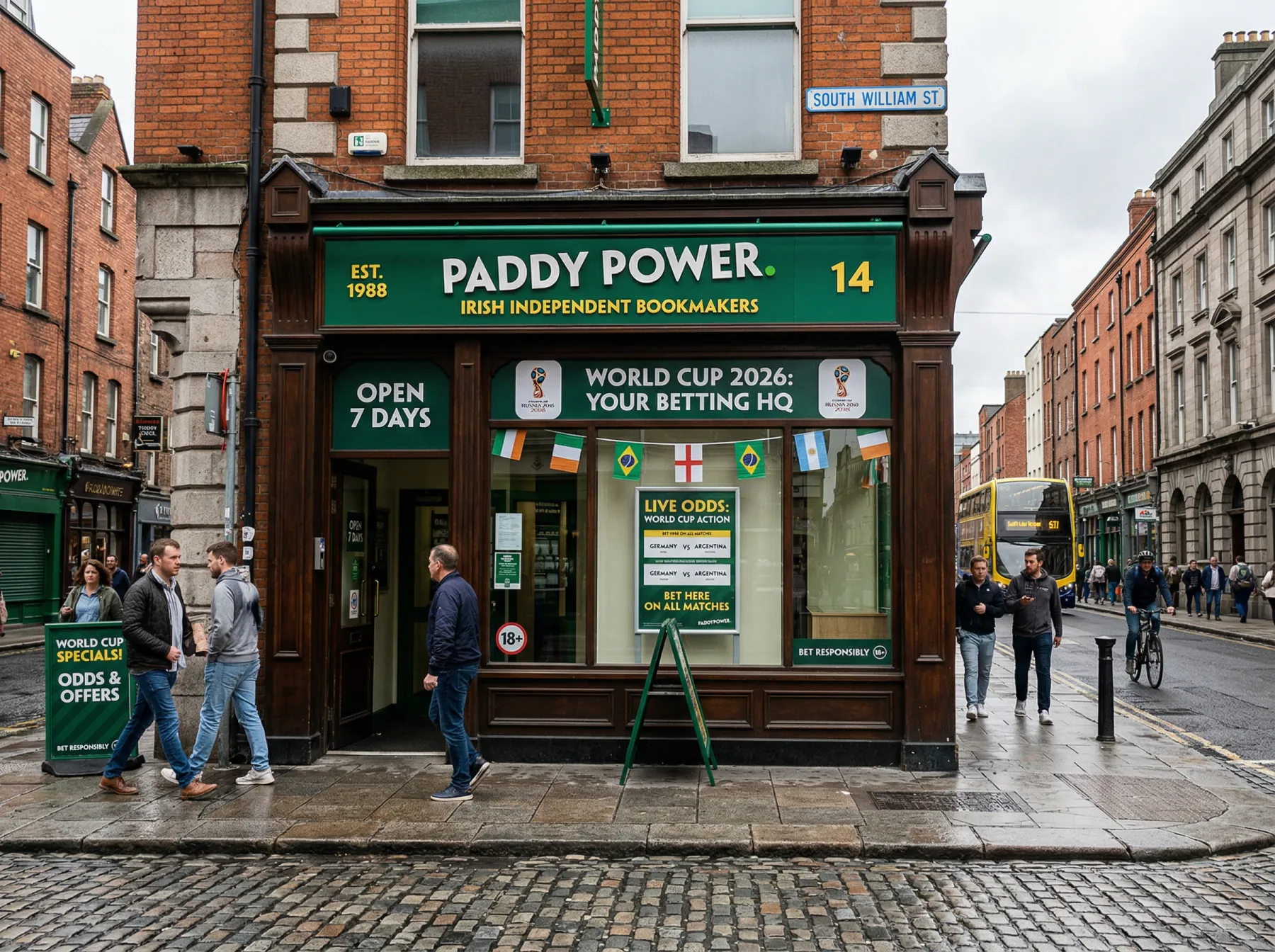
I grew up watching my father study the Racing Post at the kitchen table every Saturday morning, circling selections with a biro that was permanently lodged behind his right ear. He would walk to Paddy Power on the high street, fill in a docket by hand, and come home either delighted or philosophical. That was Irish punting for fifty years: simple, familiar, woven into the rhythm of weekends and race meetings and big football matches. Then the Gambling Regulation Act 2024 arrived, and for the first time in nearly a century, the rules of the game changed.
If you are betting on the World Cup from Ireland this summer, you are doing so under a regulatory framework that did not exist eighteen months ago. The Gambling Regulatory Authority of Ireland — GRAI — is now the sheriff, and the old Wild West days of Irish betting are officially over. This is not a bad thing. Most of the changes protect punters. But you need to understand what has shifted, what the new rules mean in practice, and how to navigate the 2026 World Cup betting landscape with clarity.
Plan your tournament schedule using the World Cup 2026 match schedule in Irish time.
The Gambling Regulation Act 2024: What Changed
For context, consider what came before. The laws governing gambling in Ireland had not been meaningfully updated since 1931. The Betting Act of that year was written for a world of horse racing and on-course bookmakers. The Gaming and Lotteries Act of 1956 addressed carnival games and parish raffles. Neither anticipated online betting, mobile apps, in-play markets, or the ability to place a live acca on a World Cup match from your sofa at two in the morning. Ireland spent decades operating one of Europe’s largest betting markets under legislation designed before television existed.
The Gambling Regulation Act 2024 replaced both statutes. It was signed into law and began its phased implementation, with the GRAI commencing operations in March 2025 and formal licensing of online operators opening on 9 February 2026 — just four months before the World Cup kicks off. The timing is not coincidental. Legislators understood that a summer of international football would be the first major test of the new framework.
At the head of the GRAI sits Paul Quinn as chairman and Anne Marie Caulfield as chief executive. The authority has the power to issue and revoke licences, investigate complaints, set advertising standards, and impose fines. This is not a toothless regulator. The GRAI can compel operators to produce records, audit their systems, and demonstrate compliance with player protection measures. Any bookmaker operating in Ireland without a GRAI licence is now committing a criminal offence.
For punters, the practical changes fall into four categories: advertising restrictions, payment limitations, self-exclusion tools, and operator conduct rules. Each of these will affect your World Cup betting experience in tangible ways, so I want to walk through them with the specificity they deserve.
The Act also establishes a Social Impact Fund, financed by a levy on licensed operators, which will support research and treatment for gambling-related harm. Ireland has one of Europe’s highest rates of problematic gambling — approximately 8% of the adult population, or around 410,000 people — and the fund represents the first dedicated public resource to address it. The World Cup, with its 39 days of continuous action and its cultural pull toward “having a flutter,” is precisely the kind of event that stress-tests both individual bankrolls and public health systems.
Advertising Restrictions: What You Will Not See This Summer
If the 2022 World Cup felt like a four-week bombardment of betting adverts, the 2026 experience will be noticeably different for Irish viewers. The GRAI has implemented a watershed rule: no gambling advertising on television or radio between 5:30 in the morning and 9:00 at night. For a tournament where most group stage matches kick off between 5pm and midnight Irish Standard Time, this means the pre-match buildup, the half-time analysis, and the post-match reaction on Irish broadcasters will be largely free of betting promotions.
Online advertising faces a different restriction. Operators can only serve targeted betting ads to users who already hold an account with them and have opted in to marketing communications. This means you will not see pop-up ads from bookmakers you have never used, no pre-roll video spots on YouTube urging you to sign up for a “World Cup welcome bonus,” and no social media campaigns designed to recruit new punters during the tournament. If you see a betting ad online during the World Cup, it should be from a bookmaker you are already registered with — and if it is not, that operator is likely violating GRAI regulations.
The restrictions extend to sponsorship and branded content. VIP programmes, loyalty schemes with tiered rewards, and bonus-based inducements designed to encourage increased spending are prohibited. The days of “bet ten get thirty free” welcome offers, which were the primary customer acquisition tool for online bookmakers in Ireland, are effectively over. Operators can still offer promotions, but these cannot be structured to incentivise escalating deposits or to target individuals who have shown signs of problematic behaviour.
For punters, this is a net positive. The advertising restrictions reduce the ambient pressure to bet more, bet bigger, and bet on impulse. You will still be able to find markets, compare odds, and place your World Cup bets — but you will be doing so because you chose to, not because an algorithm decided to serve you an advert at your most vulnerable moment.
No More Credit Card Bets: The Cashless Shift
This is the change that will hit some punters hardest. Under the GRAI framework, credit cards can no longer be used to fund betting accounts. Debit cards, bank transfers, and approved e-wallets remain available, but the ability to bet on credit — to gamble with money you do not currently have — has been removed.
The logic is straightforward. Research consistently shows that credit card gambling is associated with higher rates of problem gambling, larger average losses, and a greater likelihood of chasing losses. When you bet with your debit card, you are wagering money that exists in your account right now. When you bet with a credit card, you are wagering against future income, often at high interest rates, and the psychological distance between placing the bet and feeling the financial consequence is dangerously wide.
For the World Cup specifically, the credit card ban eliminates a common pattern: the punter who loses his bankroll in the group stage, maxes out a credit card chasing during the knockout rounds, and spends the rest of the summer paying off the interest. If your debit card balance hits zero, you are done for the day. That forced stop is a protection mechanism, even if it does not feel like one in the moment.
My advice is practical. Before the tournament starts, decide on a total World Cup betting budget. Transfer that amount to a dedicated account or e-wallet. When it is gone, it is gone. The credit card ban makes this easier to enforce because the temptation to “just top up” from a credit line no longer exists. Treat your World Cup bankroll as a finite resource — like buying a ticket to a month-long sporting event — and the enjoyment lasts regardless of results.
Fractional vs Decimal: The Irish Punter’s Choice
Every Irish betting shop displays odds in fractional format. Walk past any Paddy Power, BoyleSports, or independent bookie and the window prices read 5/1, 11/4, evens, 4/6. This is how your father bet, how his father bet, and how most Irish punters still think about value. The fractional format tells you your profit relative to your stake: 5/1 means five euro profit for every one euro staked, plus your stake back. Simple once you know it, baffling if you do not.
Online platforms increasingly default to decimal odds, which express the total return including your stake. Decimal 6.00 is the same as fractional 5/1 — a one euro bet returns six euro total (five profit plus one stake). Decimal 1.50 is the same as 1/2 — a ten euro bet returns fifteen (five profit plus ten stake). The decimal format is standard across continental Europe and is the default for most international betting exchanges.
For World Cup betting, where you might be comparing odds across multiple operators, decimal is arguably more practical. It makes comparison easier because the numbers are directly comparable — 3.75 is clearly better than 3.50, while 11/4 versus 7/2 requires a moment of mental arithmetic. Most Irish online bookmakers let you toggle between formats in your account settings, and I would recommend switching to decimal for the tournament if you are not already comfortable with it.
That said, fractional odds have an intuitive quality for certain bet types. When someone says “Scotland are 6/1 to qualify from Group C,” the meaning is immediately clear: a tenner returns seventy, including your stake back. Fractional also makes each-way calculations more transparent. At 6/1 each-way with quarter the odds for a place, the place part pays 6/4 — you can see the relationship between the numbers without a calculator.
My recommendation: use decimal for comparing prices across bookmakers and for calculating accumulator returns (multiply the decimal prices together — done). Use fractional for discussing individual bets in conversation, because that is the language of Irish punting and always will be. Both formats carry the same information. The odds are the odds. Only the notation changes.
Self-Exclusion and the National Register
The GRAI is building a National Self-Exclusion Register — a single database that allows any person in Ireland to exclude themselves from all licensed gambling operators simultaneously. Previous self-exclusion required you to contact each bookmaker individually, a process that was inconsistent, time-consuming, and easy to circumvent by simply opening an account with a different operator.
The register is still in its implementation phase and may not be fully operational by the time the World Cup begins on 11 June. However, the framework is in place, and individual operators are already required to offer self-exclusion tools on their own platforms. If you or someone you know needs to step away from betting during the tournament, the option exists at every licensed bookmaker.
Self-exclusion is not a sign of weakness. It is a tool, the same way a bankroll limit is a tool. The World Cup is a 39-day marathon of matches, and the temptation to bet every day — to have action on every kickoff — can escalate gradually in ways that are hard to recognise from the inside. If your betting stops being enjoyable, if you find yourself chasing losses or staking more than you planned, the self-exclusion register is designed for exactly that moment.
Beyond self-exclusion, the GRAI framework requires operators to implement reality checks — periodic prompts that display how long you have been logged in and how much you have wagered. These may feel intrusive, but they serve a purpose: they break the trance of continuous in-play betting during a match and force a moment of reflection. For late-night World Cup matches where Irish punters are betting at 1am or 2am after a long day, that pause can be the difference between a controlled flutter and a regrettable session.
A New Era for Irish Punting
The summer of 2026 will be the first major sporting event under Ireland’s new gambling framework, and the landscape is genuinely different. The advertising watershed means quieter broadcasts. The credit card ban means harder limits. The GRAI means accountability. None of this prevents you from betting on the World Cup — the markets are open, the operators are licensed, and the odds are waiting. What changes is the environment around the bet.
I think of it this way: Irish punting culture is not disappearing. The pub conversations about accumulators, the Saturday morning ritual with the Racing Post, the thrill of a late winner landing your coupon — all of that survives. What the new regulations remove is the infrastructure of exploitation: the predatory bonuses, the credit-fuelled chasing, the relentless advertising pressure designed to keep you betting when you should stop. What remains is the bet itself, placed with your own money, on your own terms, in a market regulated by an authority that exists to protect you.
For your World Cup 2026 experience, the practical steps are these. Check that your bookmaker holds a GRAI licence. Set your odds format preference before the tournament starts. Establish a bankroll and stick to it. Know where the self-exclusion tools are, even if you never use them. And then enjoy the football. One hundred and four matches across 39 days, from the Estadio Azteca to MetLife Stadium, with the best players on earth competing for the biggest trophy in sport. The complete betting guide covers the tactical side of your World Cup wagering. This page is about the framework around it — and that framework, for the first time in Irish history, is built to let you enjoy the flutter without the fallout.
Is online betting legal in Ireland for the 2026 World Cup?
Yes. Online betting is fully legal in Ireland under the Gambling Regulation Act 2024. Licensed operators must hold a GRAI licence, which became available from 9 February 2026. You can legally place bets on all World Cup 2026 markets through any GRAI-licensed bookmaker.
Can I still use a credit card to bet on World Cup matches in Ireland?
No. The GRAI framework prohibits the use of credit cards for gambling transactions. You can fund your betting account using debit cards, bank transfers, or approved e-wallets. This restriction applies to all licensed operators in Ireland and cannot be circumvented.
Irish punters can find top odds at World Cup Soccer IE.
