
Mexico at the 2026 World Cup
 Available in US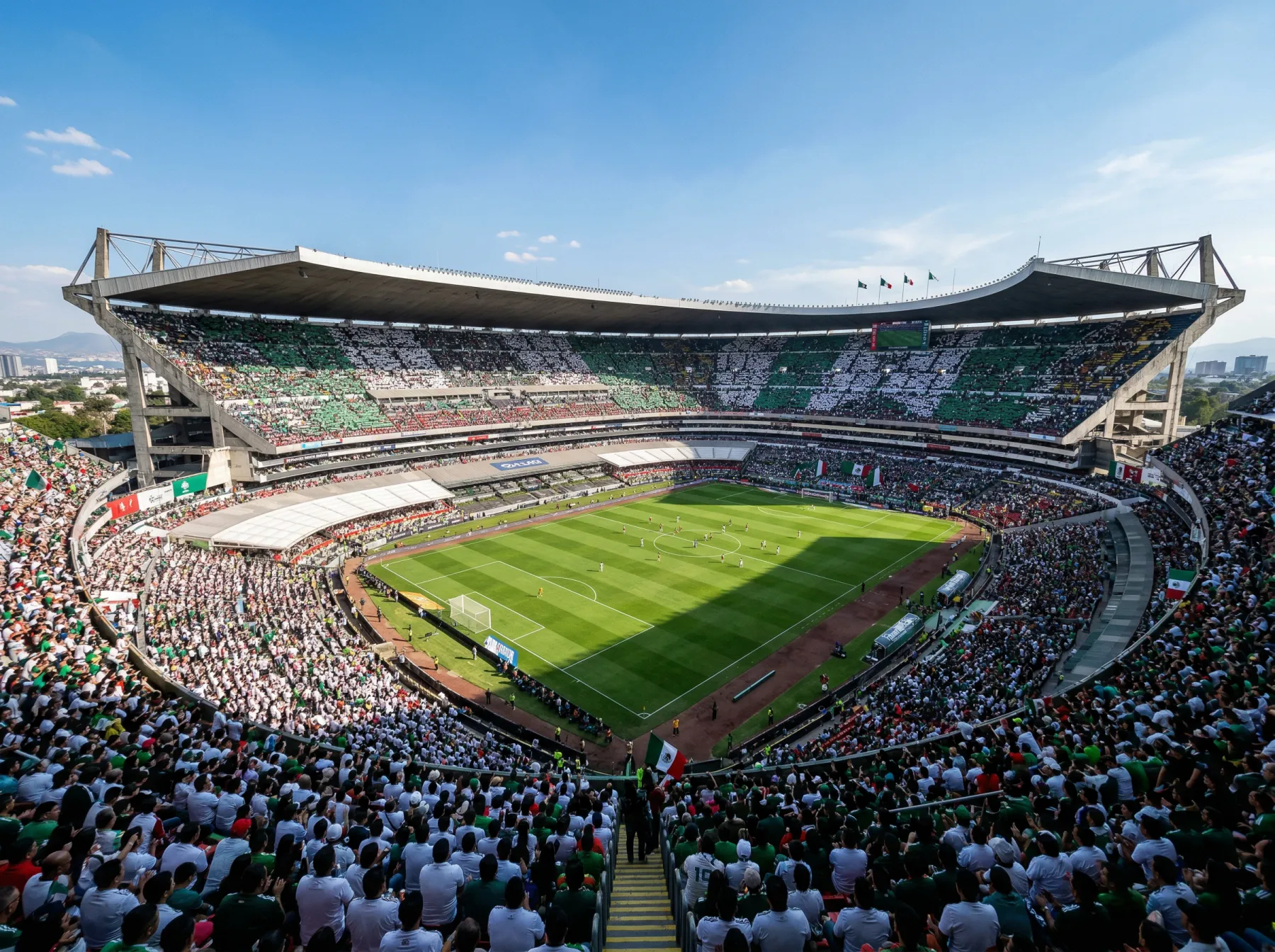
The Estadio Azteca has witnessed two of football’s most iconic moments: Pelé’s celebration after Brazil’s 1970 World Cup final victory and Diego Maradona’s “Hand of God” against England in 1986. On 11 June 2026, the stadium that has hosted more World Cup matches than any other venue on earth will add another chapter to its story when Mexico face South Africa in the tournament’s opening match. The Azteca will shake — literally, as 87,000 fans create the seismic atmosphere that has terrified visiting teams for decades — and El Tri will carry the expectations of 130 million people who see this World Cup as their footballing birthright.
Mexico are co-hosts alongside the USA and Canada, but their emotional investment in this tournament exceeds that of their neighbours. Football is not one of many sports in Mexico — it is the sport, the national obsession, the thread that connects every social class and every region. Hosting a World Cup on Mexican soil for the third time (after 1970 and 1986) creates a pressure that the squad must either harness or be crushed by, and the Group A draw — South Korea, South Africa and Czechia — provides an opportunity to channel that pressure into results.
They are also playing host, as described in the World Cup 2026 stadiums guide.
El Tri’s Squad for the Home World Cup
Mexico’s squad blends Liga MX stalwarts with a growing contingent of European-based players. The combination reflects the changing nature of Mexican football, where the best young players increasingly seek opportunities in Europe’s top leagues rather than remaining in the domestic system. The result is a squad with more tactical variety and individual quality than any Mexican side in recent memory, though it lacks the generational superstar — the Hugo Sánchez or Rafael Márquez figure — who would elevate it to genuine contender status.
Santiago Giménez leads the attack. The Feyenoord striker has developed into one of the Eredivisie’s most prolific forwards, combining clinical finishing with intelligent movement that creates chances from positions that more physically imposing strikers might not occupy. His ability to drop deep, link play with midfield runners, and then arrive in the box for the decisive touch distinguishes him from the traditional Mexican target men who preceded him. Giménez’s goal-scoring record in European football — he finished as one of the Eredivisie’s top scorers in consecutive seasons — has validated the pathway from Liga MX to Europe, and at 25 he arrives at a home World Cup in the peak of his career.
Hirving “Chucky” Lozano’s pace and directness from the wing provide the penetration that Mexico need in the final third. Lozano’s World Cup pedigree is already established — his goal against Germany in the 2018 opener in Moscow remains one of the iconic moments in Mexican football history — and his experience in European leagues (Serie A, Eredivisie) has added a tactical awareness to his raw speed that makes him more than just a one-dimensional runner. His partnership with Giménez, with the creative quality of Diego Lainez threading passes between them, gives Mexico an attacking trio that can trouble any defence at group-stage level.
Edson Álvarez anchors the midfield with the authority of a player who has competed at the highest level in Europe. The West Ham midfielder’s physical presence, his ability to break up opposition attacks, and his passing range from deep positions give Mexico a platform that allows the more attacking players to express themselves without worrying about defensive cover. Álvarez’s experience in the Premier League — where the tempo and physicality exceed anything the group-stage opponents will produce — means he’s well-prepared for the demands of tournament football.
In defence, Cesar Montes and Johan Vásquez provide the centre-back partnership, with Jorge Sánchez at right-back offering the overlapping runs that Mexico’s system encourages. The defensive unit is organised and competent without being spectacular, and the goalkeeping position — Guillermo Ochoa’s era has ended, with younger options stepping into the role — brings fresh energy if not the same matchday experience. The squad’s depth is its primary limitation: while the starting eleven can compete with most group-stage opponents, the bench options lack the quality that the USA or European co-contenders can call upon when tactical adjustments or fatigue management require changes.
Group A: Mexico, South Korea, South Africa and Czechia
Mexico’s group is designed for drama rather than difficulty. South Korea bring the pedigree of their extraordinary 2002 World Cup run (semi-finalists on home soil) and a squad that has produced consistent results in Asian football, with Son Heung-min — now 33 but still one of Asia’s most dangerous attackers, his Tottenham Hotspur career having produced over 100 Premier League goals — leading from the front. The Korean squad also features several young players from the Bundesliga and Serie A who add technical quality to the traditional Korean strengths of fitness, discipline, and tactical organisation. The Mexico vs South Korea match carries echoes of their 2018 World Cup encounter, which Mexico won 2-1 in Rostov, and a similar outcome would set El Tri on course for a comfortable group-stage campaign. However, the possibility of South Korea springing an upset — as they did against Germany in that same 2018 tournament, winning 2-0 to send the defending champions home — means this is not a fixture to take for granted.
South Africa’s appearance at the opening match creates a unique dynamic. La Bafana Bafana qualified through the African pathway and carry the memory of being the first African nation to host a World Cup (2010), though their squad lacks the individual quality of Morocco, Nigeria or Senegal. Mexico should handle this fixture — particularly given the Azteca’s home advantage and the emotional energy of the opening match — though an early tournament upset is never impossible.
Czechia — the team that ended Ireland’s World Cup dream in that Prague penalty shoot-out — bring European tactical discipline and a squad with Bundesliga and Premier League experience. They’re a well-organised side who won’t be overawed by the atmosphere but may struggle to match Mexico’s intensity in front of a home crowd. Mexico to beat Czechia is a reasonable bet at around 8/13, with the home advantage and crowd factor providing the edge.
Mexico should top this group with seven to nine points. The South Korea match is the most competitive, and the opening fixture against South Africa carries the emotional weight that opening matches always do, but the overall quality level of the group favours El Tri comfortably.
The Azteca Factor: Why the Opening Match Matters
Playing the opening match of a World Cup is both a privilege and a burden. The entire football world is watching — not just the match itself, but the ceremony, the atmosphere, the emotional intensity of a nation welcoming the world. Mexico at the Azteca on 11 June will be watched by an estimated television audience of over one billion people, and the pressure of performing on that stage — where a poor result would set the tone for the entire tournament from a Mexican perspective — is substantial.
The Azteca’s altitude (2,240 metres above sea level) is a tangible home advantage. Visiting teams who aren’t accustomed to playing at altitude experience reduced stamina, heavier legs in the second half, and a ball that moves faster through the thinner air. Mexico’s players, many of whom grew up playing at altitude in Liga MX, are naturally acclimatised, and the conditioning difference typically manifests after the 60th minute, when opponents begin to fade and Mexican substitutes arrive with the energy advantage that altitude provides.
For punters, the opening match presents a specific opportunity. Host nations have won their opening match at five of the last eight World Cups, and the combination of crowd advantage, tactical familiarity with the venue, and the emotional lift of opening a home tournament creates a probability uplift that isn’t always fully priced into the market. Mexico to win the opening match against South Africa at around 2/5 is short but reliable, and Mexico to score first in the opening match is available at approximately 1/3 — a solid base for accumulator building on the tournament’s opening day.
Mexico’s Odds and Host Nation Angle
Mexico are priced at approximately 50/1 (51.00 decimal) to win the 2026 World Cup, which accurately reflects their status as a competitive but not elite side. The realistic ceiling for this squad is the quarter-finals, where they’d likely face one of the genuine contenders and be eliminated — a pattern Mexican football has endured at every World Cup since 1986, earning the sobriquet “Quinto Partido” (the fifth match) for their inability to win that crucial knockout round fixture. Seven consecutive Round of 16 exits between 1994 and 2018 created a psychological ceiling that this squad must shatter if they’re to justify the investment of hosting.
The host nation factor adds complexity to the odds assessment. Home advantage at World Cups has historically provided a significant boost — South Korea reached the semi-finals in 2002, Germany the semis in 2006, and Brazil the semis in 2014, all exceeding pre-tournament expectations. If Mexico can channel the Azteca’s energy into their opening matches and build momentum through the group stage, the knockout round becomes a different proposition when 87,000 fans are willing them forward. The “Quinto Partido” curse may finally break if it’s played in front of a home crowd rather than in a neutral venue thousands of miles from Mexico City.
My view: Mexico’s value lies in the group markets rather than the outright. Mexico to win Group A at around 4/6 is a reliable bet for accumulator purposes, and Giménez to be the group’s top scorer at approximately 5/2 reflects both his quality and Mexico’s expected dominance of the weaker fixtures. The opening match provides specific prop opportunities — Mexico team total over 1.5 goals against South Africa, first-half goals in the opening fixture — that are more profitable than speculating on a deep tournament run.
El Tri’s Moment on the World Stage
Mexico’s World Cup campaign is less about winning the trophy and more about the experience of hosting, performing, and demonstrating to the world that Mexican football has continued to develop since the glory days of 1986. The Azteca on 11 June will produce one of the most electrifying atmospheres in World Cup history, the Mexican fans will bring a passion and colour that no other nation can match, and El Tri’s players will play with the intensity that only a home crowd can generate.
For Irish punters watching from Dublin or Galway, Mexico’s matches will be among the most entertaining at the tournament — the atmosphere alone makes them appointment viewing. Back the group results with confidence, enjoy the spectacle, and appreciate the rare privilege of watching a World Cup opening match at a venue with the historical weight of the Estadio Azteca. Some things in football are bigger than the betting slip.
When is Mexico"s opening match at the 2026 World Cup?
Mexico play South Africa in the tournament"s opening match on 11 June 2026 at the Estadio Azteca in Mexico City. It will be the third time the Azteca has hosted a World Cup match, following the 1970 and 1986 tournaments.
What group are Mexico in at the 2026 World Cup?
Mexico are in Group A alongside South Korea, South Africa and Czechia. As co-hosts, Mexico are expected to top the group and qualify comfortably for the knockout rounds.
Support El Tri on our startpage.
