
Hard Rock Stadium: Miami Venue Guide
 Available in US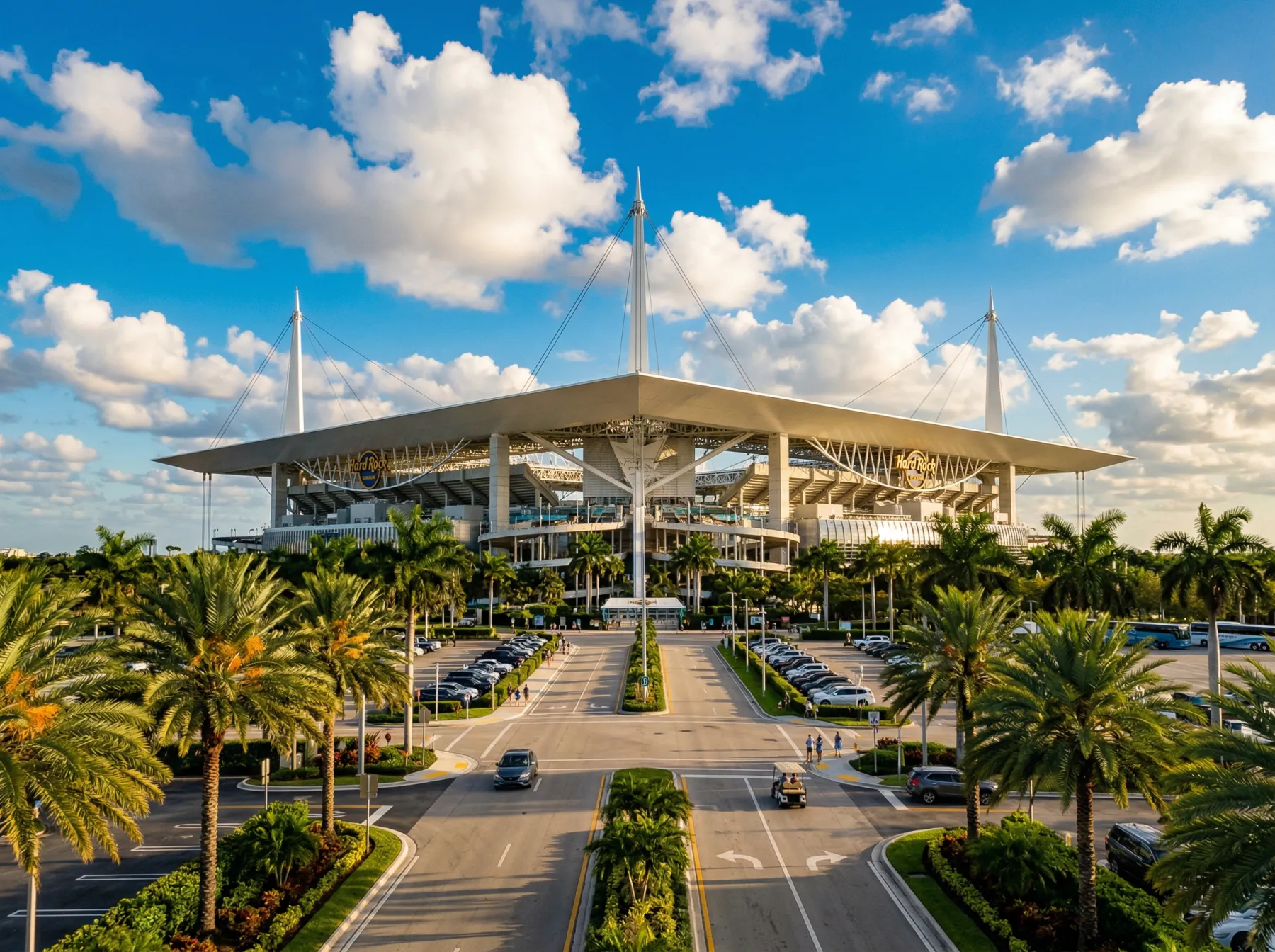
Miami has always been a football city — just not in the way most Europeans would recognise. It is a city where Argentine taxi drivers debate Boca Juniors transfers, where Colombian restaurant owners close shop early for Copa Libertadores nights, and where the local MLS franchise, Inter Miami, became globally relevant the moment Lionel Messi stepped off a plane in 2023. Hard Rock Stadium, sitting in the suburban sprawl of Miami Gardens about 25 kilometres north of downtown, is where all that Latin American football passion meets American sporting infrastructure at the 2026 World Cup.
I have covered matches in hot climates across three continents, and the conditions at Hard Rock Stadium are among the most extreme any World Cup venue will offer. The combination of heat, humidity and the intensity of a knockout-stage match creates a physical test that goes beyond tactics and talent. For punters, these conditions are not background detail — they are variables that directly influence match outcomes and betting value.
Miami’s venue is a key part of our complete World Cup 2026 stadiums guide.
Hard Rock Stadium: From NFL to FIFA
Hard Rock Stadium opened in 1987 as Joe Robbie Stadium — named after the Miami Dolphins’ owner who financed its construction — and has undergone so many renovations and name changes that listing them all would read like a corporate merger timeline. The current iteration, following a $550 million renovation completed in 2016, features a distinctive canopy roof structure that shades most of the seating bowl without fully enclosing it. The canopy was designed primarily for the tennis events that Hard Rock also hosts (it is the home of the Miami Open), but for World Cup football, it provides partial shade that will be welcomed by fans in the upper tiers.
The capacity for football matches sits at approximately 65,000, placing it in the mid-range of World Cup 2026 venues. The pitch will be natural grass — installed temporarily for the tournament — on a surface that sits below the surrounding grade, creating a bowl effect that traps both sound and heat. The acoustics are solid for an American stadium: the canopy reflects crowd noise back toward the pitch, and during well-attended matches, the atmosphere can approach European standards of intensity.
South Florida’s Latin American communities will fill this stadium for every fixture. Miami-Dade County is majority Hispanic, with enormous populations of Cuban, Colombian, Venezuelan, Argentine, Brazilian and Haitian descent. Any match involving a South American or Central American nation will feel like a home fixture, with the crowd overwhelmingly supporting the Latin American side. That atmosphere is worth accounting for in your pre-match assessment: a match between, say, Argentina and an Asian or European opponent at Hard Rock will not feel like a neutral venue. The crowd energy will favour Argentina heavily, and that psychological edge matters in tight matches.
The stadium’s location in Miami Gardens — a predominantly Black community — also connects to Ghana and other African nations whose diaspora communities are strong in South Florida. If Ghana or Senegal draw a match at Hard Rock, the local support could be significant, creating a quasi-home atmosphere that the general betting market may not fully price in. Venue-specific crowd composition is one of the under-analysed variables at a multi-city World Cup, and Miami is the most extreme example in this tournament.
World Cup 2026 Matches in Miami
Hard Rock Stadium is designated as a semi-final venue, which immediately elevates its importance in the tournament’s narrative. The semi-finals, played on 15 and 16 July, are the last step before the final, and the intensity of those matches — combined with Miami’s brutal July conditions — will produce some of the most physically demanding football at the entire tournament. FIFA’s allocation of a semi-final to Hard Rock means the stadium will also host group-stage matches and at least one earlier knockout fixture, giving us data points on how the venue’s conditions affect play before the marquee matches arrive.
The group-stage matches at Hard Rock will likely feature at least one host-nation fixture — potentially a USA match, given the geographic proximity — and one or two fixtures involving South American or CONCACAF teams. The specific assignments depend on the scheduling matrix, but expect the stadium to be used for four to six total matches across the tournament. Each of those matches provides information about how the pitch plays, how the heat affects second-half intensity, and how the crowd composition shapes the atmosphere.
For the semi-final specifically, the betting implications of venue conditions are significant. By 15 July, squads will have been competing for over five weeks. The cumulative fatigue of a six-or-seven-match run through the tournament, combined with mid-July Miami heat that regularly exceeds 32 degrees Celsius with 75% humidity, will test the depth of every remaining squad. Teams with stronger benches — those that can rotate fresh legs for tired ones in the 60th minute — will hold a measurable advantage. This is why the top-heavy squads with world-class starting elevens but limited bench quality sometimes falter at the semi-final stage: the conditions at venues like Hard Rock punish shallow squad depth more than any tactical adjustment can compensate for.
Miami Gardens: Heat, Humidity and What It Means for Football
July in Miami Gardens is not simply hot. It is oppressively, saturatingly, inescapably hot. The average high temperature in mid-July is 33 degrees Celsius, but the humidity — which routinely sits above 70% — pushes the “feels like” temperature into the high thirties or low forties. For footballers accustomed to European summer conditions of 20-25 degrees, the adjustment is severe. Even for South American and African players who have experienced tropical heat, the combination of Miami’s humidity with the exertion of a World Cup knockout match is at the extreme end of what the human body can manage while maintaining elite athletic performance.
The physiological effects are predictable and measurable. Core body temperatures rise faster, sweat rates increase dramatically, and the onset of muscular fatigue arrives earlier in the match. FIFA mandates cooling breaks in matches played above certain temperature thresholds — typically at the 30th and 75th minute — which provides some relief but does not eliminate the cumulative effect. The practical result is that matches at Hard Rock, particularly those played in afternoon or early-evening slots, will see a noticeable decline in pressing intensity from both sides in the second half.
That decline has direct betting implications. The over/under goals markets for second halves at Hard Rock should reflect a higher scoring rate than the tournament average, because defensive structures loosen when players cannot sustain the sprinting required to maintain shape. Conversely, the first half of matches at Hard Rock may produce fewer goals than expected, as both sides conserve energy in anticipation of the heat’s effect later in the match. The half-time under 0.5 goals market for afternoon kick-offs at this venue is worth examining — teams will not burn energy pressing high in the first 45 minutes if they know the second half will demand every ounce of physical reserve they possess.
Hydration and medical preparation will be a genuine factor for every team playing in Miami. Squads that have invested in heat-acclimatisation protocols — spending time in warm-weather training camps before the tournament or arriving in Florida early enough to adjust — will perform measurably better than those that fly in from a cooler climate and play within 48 hours. This information is not always publicly available, but team press conferences and media reports in the days before a match at Hard Rock often reveal which sides have taken heat preparation seriously and which have not. That intelligence feeds directly into your pre-match model and can shift your position on the match result or total goals.
The weather also affects the pitch. Natural grass in Miami’s climate requires constant irrigation and maintenance, and the surface will be softer and slower than pitches at cooler, drier venues. A soft, slow surface favours physical teams that rely on direct play and penalises technically gifted sides that depend on quick ball movement. If you are backing a team like Spain or Japan — sides built on rapid passing and positional play — their matches at Hard Rock will present tougher conditions than the same fixtures at a venue like MetLife or BMO Field in Toronto. Factor the surface into your assessment, particularly for matches in the later rounds when the pitch has endured multiple fixtures and may have deteriorated.
Hard Rock Stadium is not the most famous venue at this World Cup, nor is it the largest. But it may be the most impactful in terms of its effect on match outcomes. The heat, the humidity, the crowd composition, the surface conditions — every one of these variables pushes match dynamics away from the default models and toward something more specific, more local, more influenced by the physical environment than by what happens on the training ground. The full stadiums guide covers all sixteen venues, but if you read only one venue profile before the tournament, make it this one. Miami will produce surprises, and those surprises will create betting value for anyone who has done their homework.
What World Cup 2026 matches will be played at Hard Rock Stadium in Miami?
Hard Rock Stadium is confirmed as a semi-final venue for the 2026 World Cup, and will also host group-stage matches and at least one earlier knockout fixture. The specific match assignments depend on the scheduling matrix, but expect four to six total matches at the venue across the tournament.
How hot will it be at Hard Rock Stadium during the 2026 World Cup?
Mid-July temperatures in Miami Gardens average 33 degrees Celsius with humidity regularly above 70%, creating a feels-like temperature in the high thirties or low forties. FIFA mandates cooling breaks in matches played above certain temperature thresholds, but the conditions will significantly affect player performance, particularly in the second half of matches.
Follow the Miami matches via World Cup Soccer IE.
